Connecting past experiences to the immediate present can be a tricky linguistic milestone for developing writers. Using targeted present perfect tense worksheets helps school students bridge this gap by showing how past events maintain critical importance right now.
When children practice blending helper verbs like “has” or “have” with accurate past participle forms, their everyday compositions instantly gain depth. This curated set of classroom materials gives educators and parents a structured framework to polish student editing capabilities and secure a strong foundation in core language mechanics.
Master Past Participles Using Our Free Present Perfect Tense Worksheets With Answers and PDF
Developing confidence in verb conjugation requires varied practice that goes far beyond simple rote memorization. The comprehensive printables provided below challenge students to sort singular and plural auxiliary alignments, convert declarations into negative forms, and hunt down subtle spelling errors in continuous sentences.
Answers
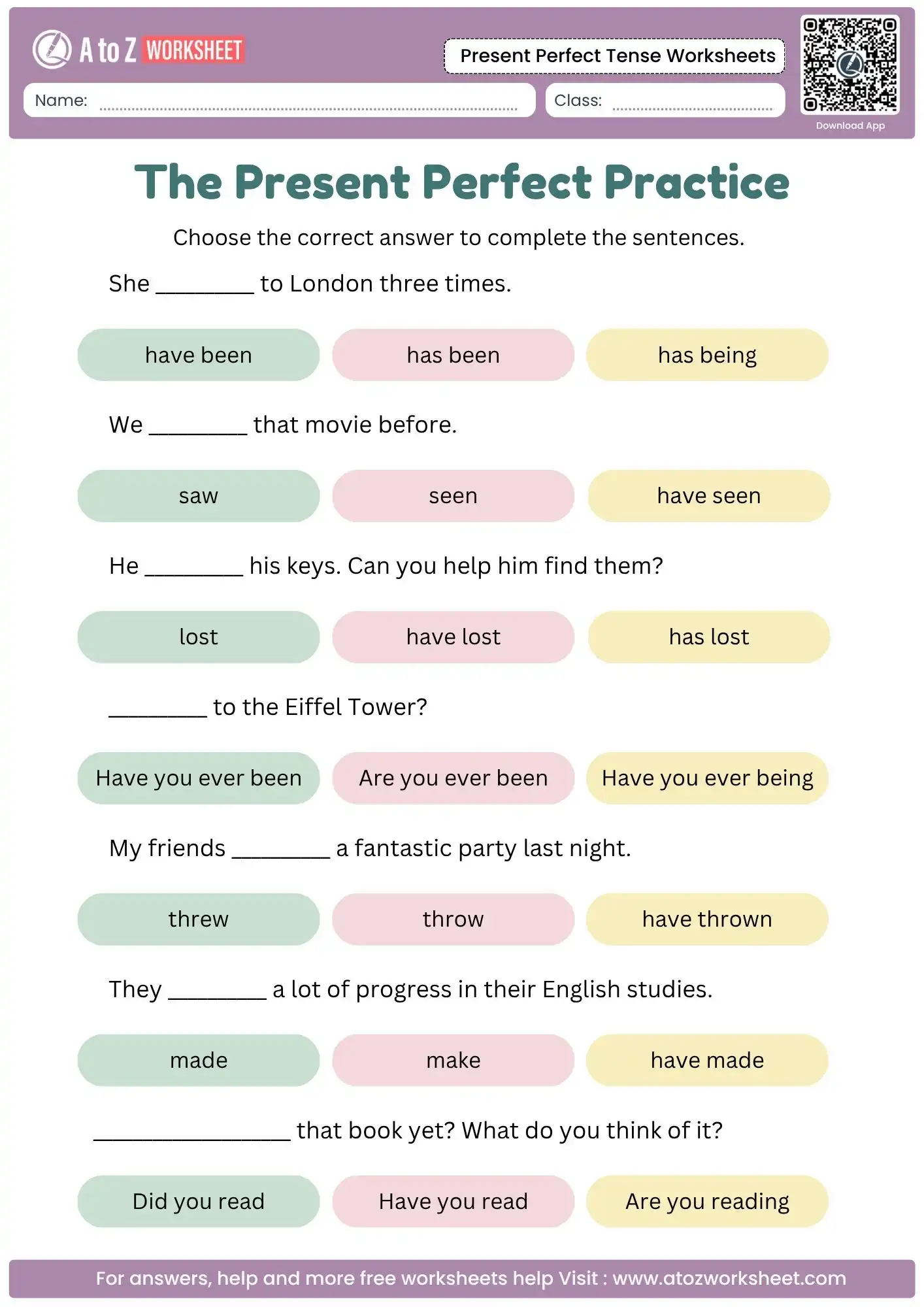
Worksheet 1
- She has been to London three times.
- We have seen that movie before.
- He has lost his keys. Can you help him find them?
- Have you ever been to the Eiffel Tower?
- My friends threw a fantastic party last night.
- They have made a lot of progress in their English studies.
- Have you read that book yet? What do you think of it?
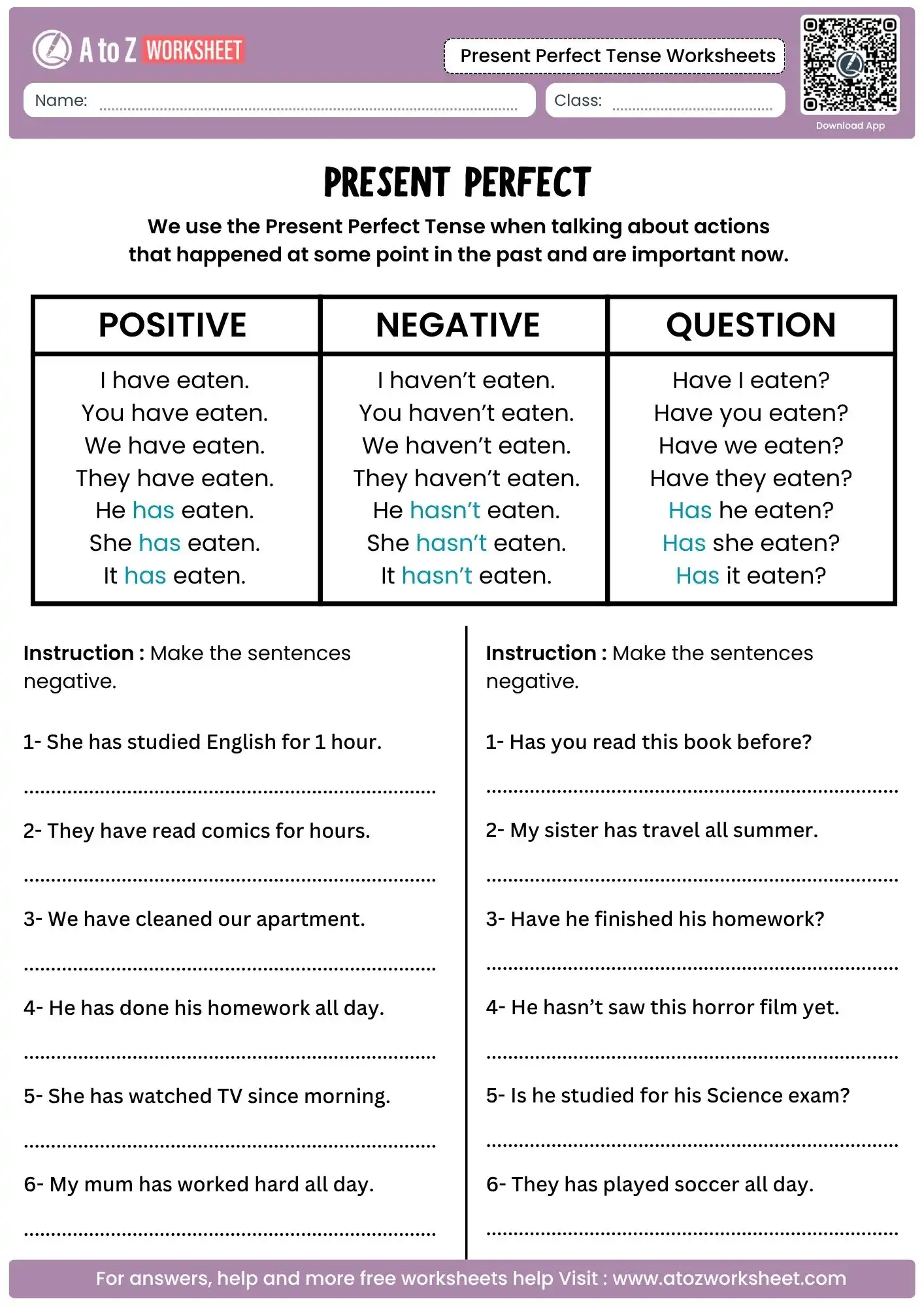
Worksheet 2
Make the sentences negative
- She has not studied English for 1 hour. (Or: She hasn’t studied…)
- They have not read comics for hours. (Or: They haven’t read…)
- We have not cleaned our apartment. (Or: We haven’t cleaned…)
- He has not done his homework all day. (Or: He hasn’t done…)
- She has not watched TV since morning. (Or: She hasn’t watched…)
- My mum has not worked hard all day. (Or: My mum hasn’t worked…)
Correct the Sentences (Error Correction)
- Have you read this book before? (Error: Has -> Have)
- My sister has traveled all summer. (Or: …has travelled… | Error: travel -> traveled V3)
- Has he finished his homework? (Error: Have -> Has)
- He hasn’t seen this horror film yet. (Error: saw V2 -> seen V3)
- Has he studied for his Science exam? (Error: Is -> Has)
- They have played soccer all day. (Error: has -> have)
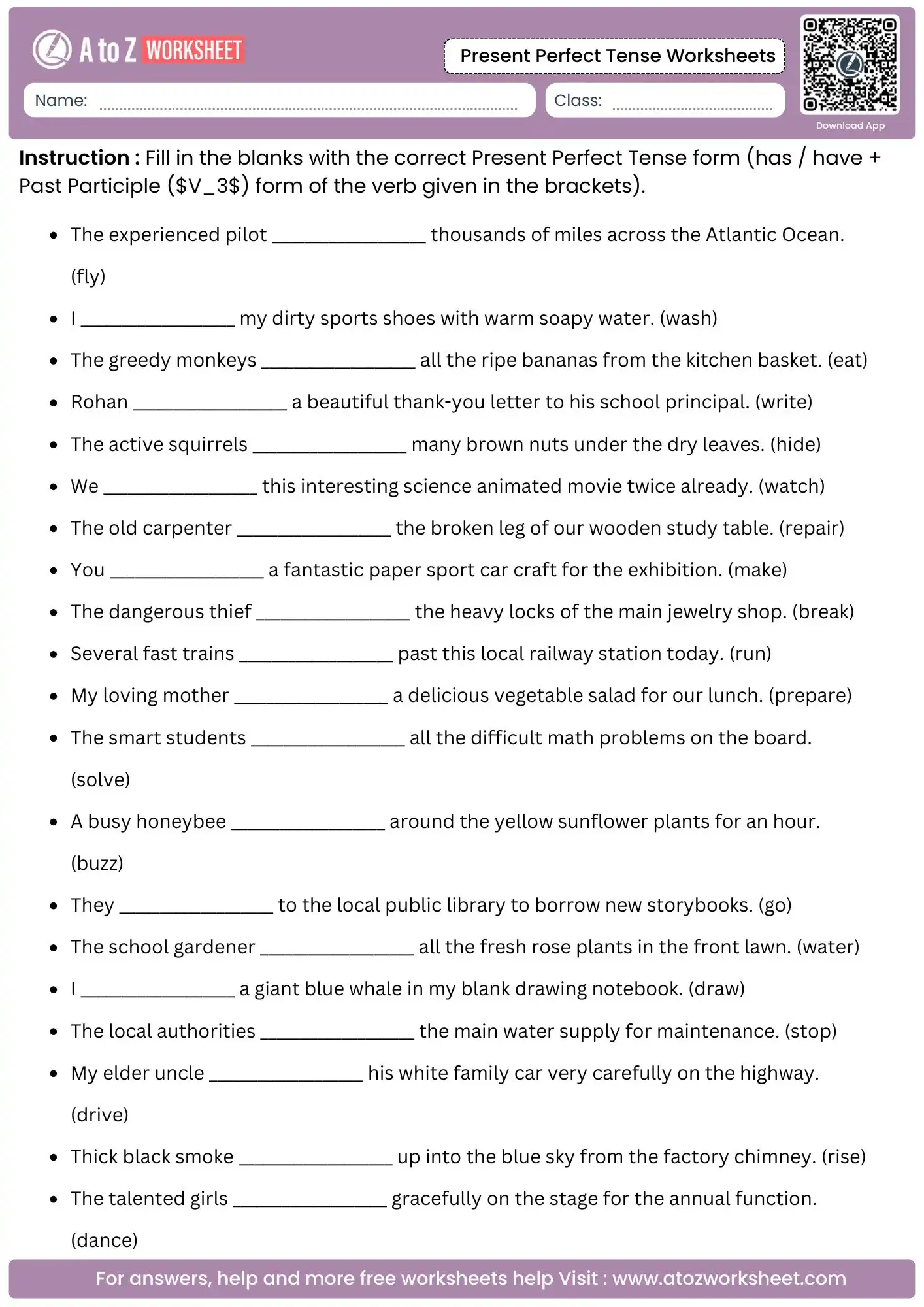
Worksheet 3
- has flown — The experienced pilot has flown thousands of miles across the Atlantic Ocean.
- have washed — I have washed my dirty sports shoes with warm soapy water.
- have eaten — The greedy monkeys have eaten all the ripe bananas from the kitchen basket.
- has written — Rohan has written a beautiful thank-you letter to his school principal.
- have hidden — The active squirrels have hidden many brown nuts under the dry leaves.
- have watched — We have watched this interesting science animated movie twice already.
- has repaired — The old carpenter has repaired the broken leg of our wooden study table.
- have made — You have made a fantastic paper sport car craft for the exhibition.
- has broken — The dangerous thief has broken the heavy locks of the main jewelry shop.
- have run — Several fast trains have run past this local railway station today.
- has prepared — My loving mother has prepared a delicious vegetable salad for our lunch.
- have solved — The smart students have solved all the difficult math problems on the board.
- has buzzed — A busy honeybee has buzzed around the yellow sunflower plants for an hour.
- have gone — They have gone to the local public library to borrow new storybooks.
- has watered — The school gardener has watered all the fresh rose plants in the front lawn.
- have drawn — I have drawn a giant blue whale in my blank drawing notebook.
- have stopped — The local authorities have stopped the main water supply for maintenance.
- has driven — My elder uncle has driven his white family car very carefully on the highway.
- has risen — Thick black smoke has risen up into the blue sky from the factory chimney.
- have danced — The talented girls have danced gracefully on the stage for the annual function.
Worksheet 4
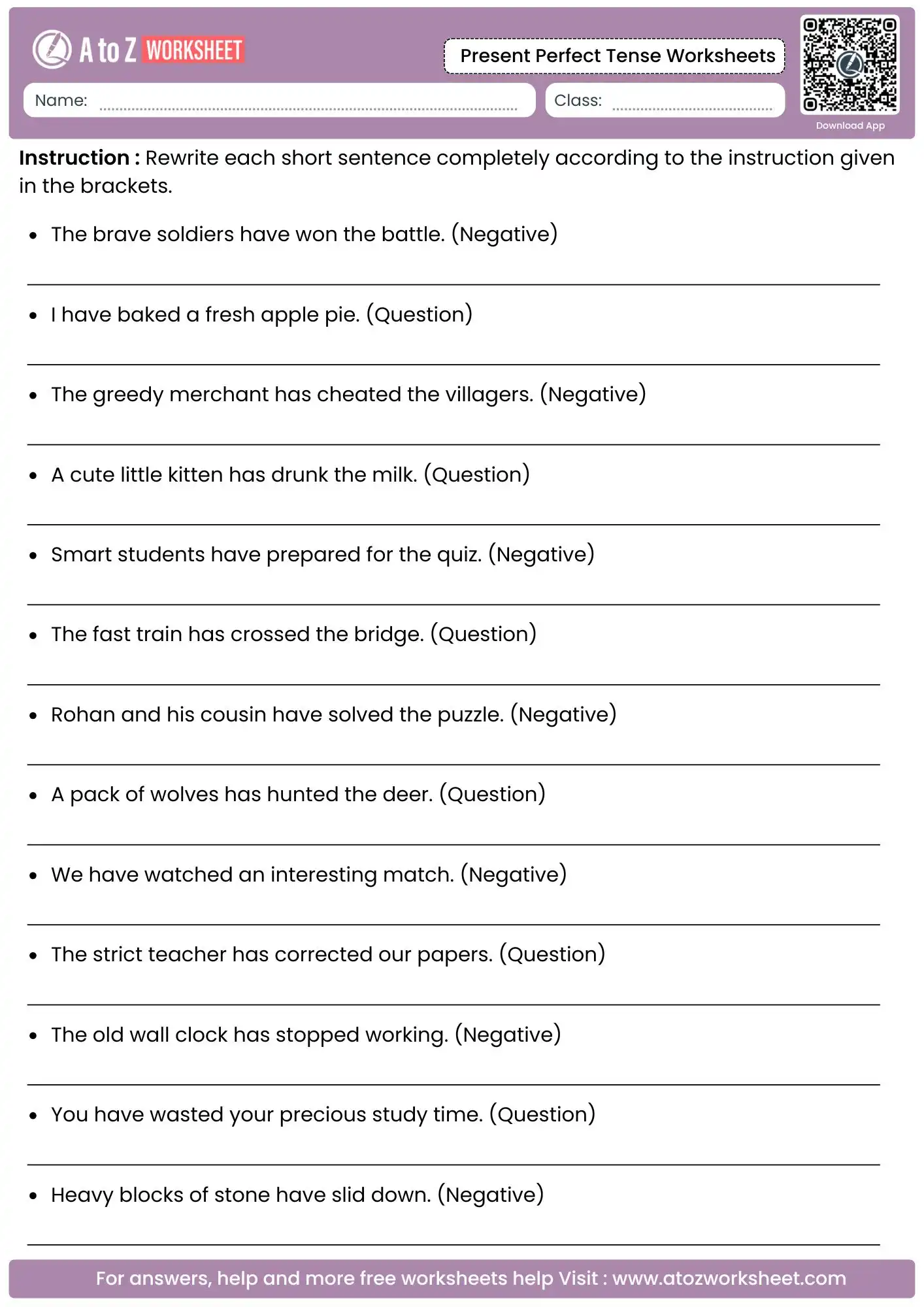
- The brave soldiers have not won the battle. (Or: …haven’t won…)
- Have I baked a fresh apple pie?
- The greedy merchant has not cheated the villagers. (Or: …hasn’t cheated…)
- Has a cute little kitten drunk the milk?
- Smart students have not prepared for the quiz. (Or: …haven’t prepared…)
- Has the fast train crossed the bridge?
- Rohan and his cousin have not solved the puzzle. (Or: …haven’t solved…)
- Has a pack of wolves hunted the deer?
- We have not watched an interesting match. (Or: …haven’t watched…)
- Has the strict teacher corrected our papers?
- The old wall clock has not stopped working. (Or: …hasn’t stopped…)
- Have you wasted your precious study time?
- Heavy blocks of stone have not slid down. (Or: …haven’t slid…)
Worksheet 5
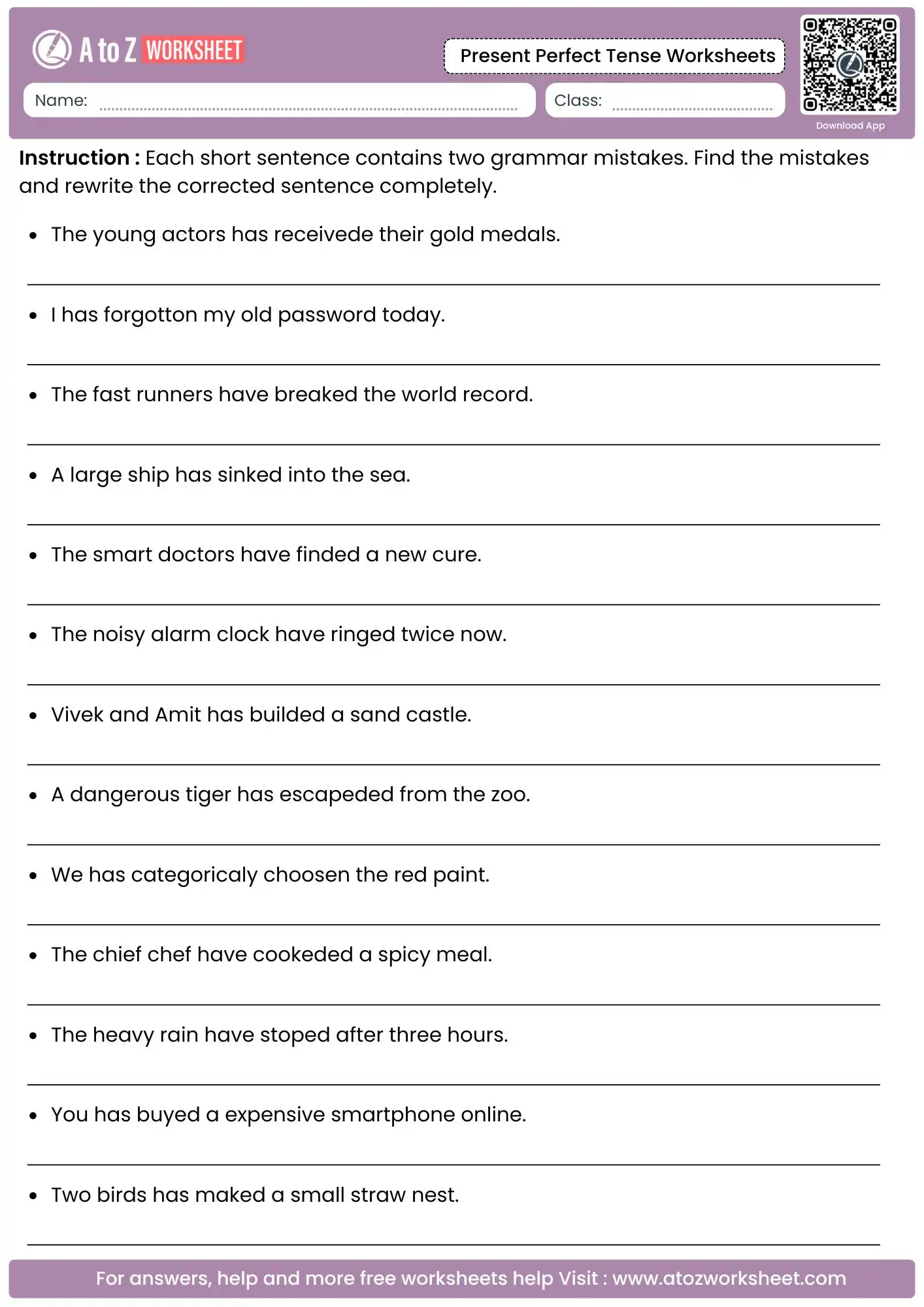
- The young actors have received their gold medals. (Errors: has -> have, receivede -> received)
- I have forgotten my old password today. (Errors: has -> have, forgotton -> forgotten)
- The fast runners have broken the world record. (Errors: have -> have / text check, breaked -> broken)
- A large ship has sunk into the sea. (Errors: have -> has, sinked -> sunk)
- The smart doctors have found a new cure. (Errors: has -> have, finded -> found)
- The noisy alarm clock has rung twice now. (Errors: have -> has, ringed -> rung)
- Vivek and Amit have built a sand castle. (Errors: has -> have, builded -> built)
- A dangerous tiger has escaped from the zoo. (Errors: have -> has, escapeded -> escaped)
- We have categorically chosen the red paint. (Errors: has -> have, choosen -> chosen)
- The chief chef has cooked a spicy meal. (Errors: have -> has, cookeded -> cooked)
- The heavy rain has stopped after three hours. (Errors: have -> has, stoped -> stopped)
Present Perfect Tense Worksheets PDF Free Download
Instructors and parents can easily download this entire multi-page workbook to enrich their current English grammar lessons. Simply tap the secure file path provided below to access your high-quality archive.
Learning Outcome
Working through these irregular verb matrices helps students confidently pinpoint how specific time indicators change the entire flow of a sentence. Regular engagement with these layouts eliminates the habit of using simple past forms accidentally, ensures correct auxiliary agreement, and gives young learners the functional tools they need to describe life events with total precision.
Related Worksheets May You Like
FAQs
Why do irregular verbs present such a major hurdle during these grammar lessons?
Unlike standard verbs that simply add a classic suffix, irregular forms change their internal vowels entirely, turning “fly” into “flown” or “write” into “written.”
How do time markers like “yet” or “already” influence these sentence structures?
These specific adverbial additions naturally signal that an action holds contemporary relevance, which makes using present perfect tense worksheets essential for students to visualize exactly where to position them.
What is the most effective way to help a student who struggles with subject-auxiliary agreement?
Have them map out singular pronouns next to “has” and plural entities next to “have” before they attempt any long-form writing prompts.
Summary
Moving beyond rigid fill-in-the-blank routines is the secret to helping children truly understand how different time frames connect in speech. Integrating these creative learning sheets into your weekly study rhythm gives young writers a dependable way to smooth out their grammar habits and build strong essays with absolute confidence.
I hope you like it and to get such worksheets for students on different topics, keep visiting our website atozworksheet.com. For instant updates, follow us on Instagram, Facebook, Pinterest, Telegram and subscribe to our YouTube channel.