Recognizing how chronological variations alter sentence formats is a key milestone for young learners as they build their fundamental communication skills. Utilizing interactive identify the tense worksheets provides children with a structured environment to analyze verbs and separate past, present, and future timelines.
Instead of jumping straight into complex essay composition, breaking down sentences to identify tenses helps students recognize language patterns naturally. These high-quality educational layouts are perfect for both home revision and active classroom study tracks.
Improve English Grammar Skills Using Free Identify The Tense Worksheets For Class 3 To Class 6
Mastering structural shifts across simple, continuous, and perfect verb structures requires direct practice with real sentence examples. The educational activity sheets arranged below help students spot crucial time clues and structural helper words through simple sorting grids and line-by-line sentence analysis blocks.
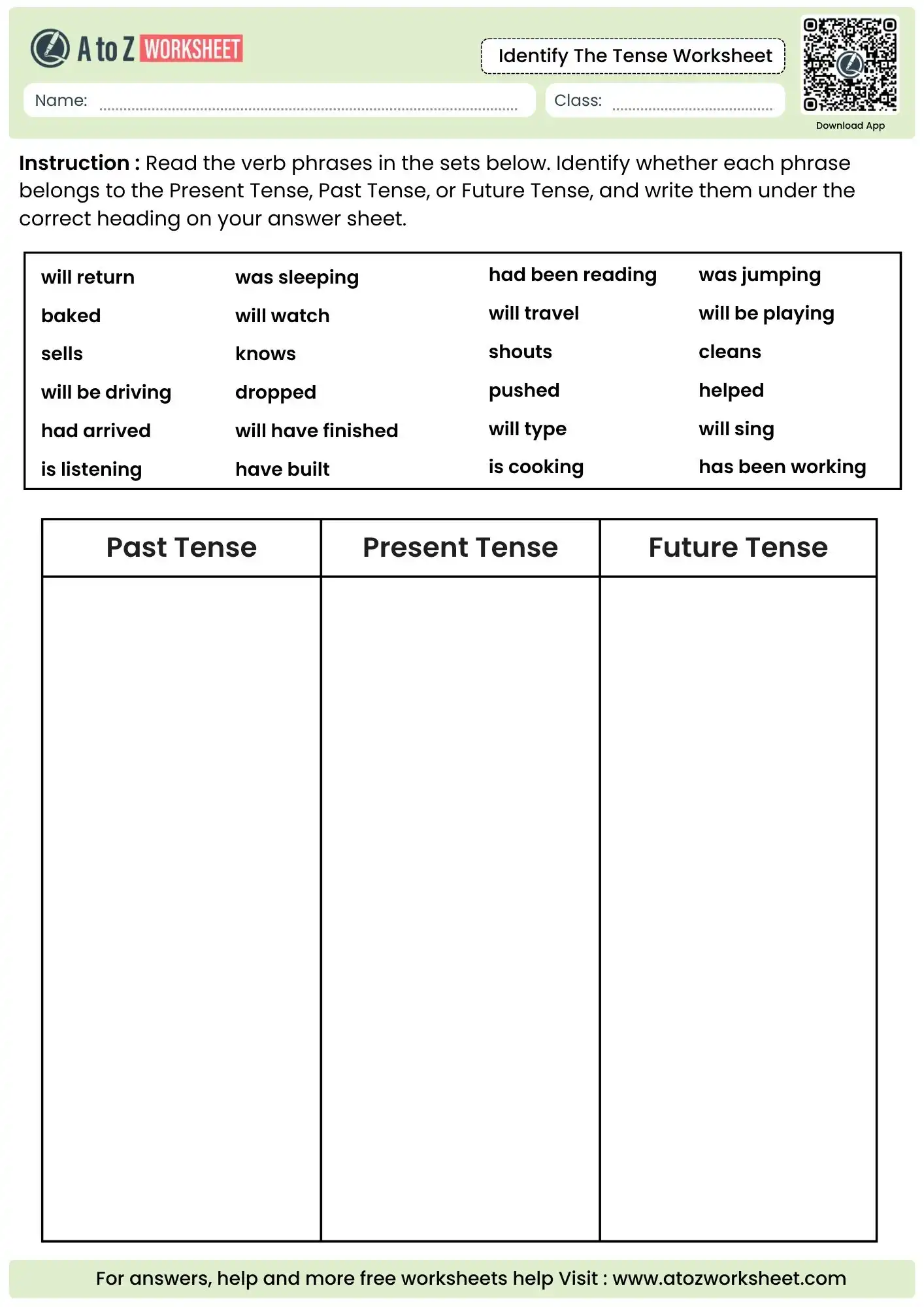
Answers
Worksheet 1
- Present Tense: sells, is listening, knows, have built, shouts, is cooking, cleans, has been working, brings, teaches
- Past Tense: baked, had arrived, was sleeping, dropped, had been reading, pushed, was jumping, helped, had opened, chased
- Future Tense: will return, will be driving, will watch, will have finished, will travel, will type, will be playing, will sing, will create, will have arrived
Worksheet 2
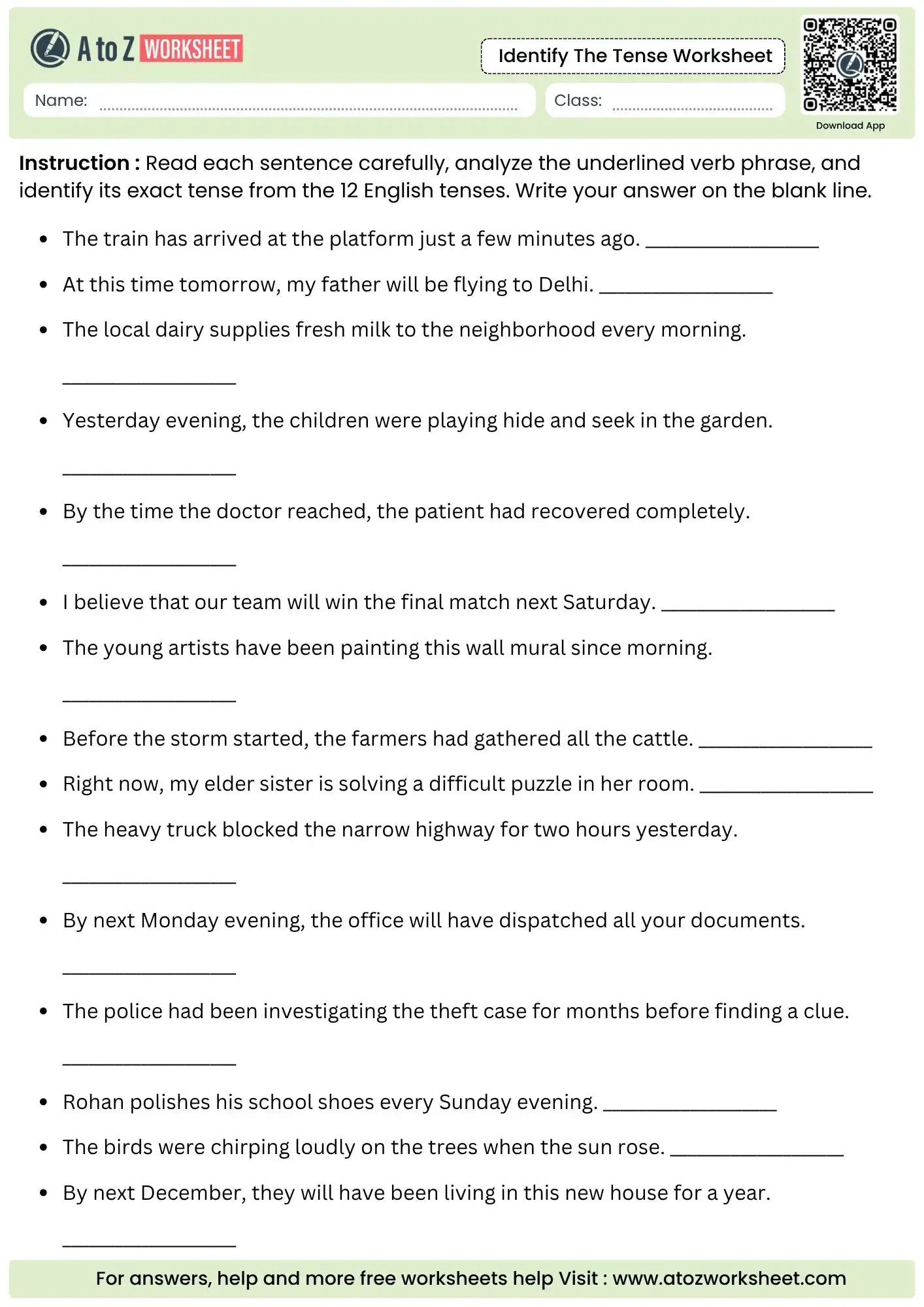
- Present Perfect Tense — The train has arrived at the platform just a few minutes ago.
- Future Continuous Tense — At this time tomorrow, my father will be flying to Delhi.
- Simple Present Tense — The local dairy supplies fresh milk to the neighborhood every morning.
- Past Continuous Tense — Yesterday evening, the children were playing hide and seek in the garden.
- Past Perfect Tense — By the time the doctor reached, the patient had recovered completely.
- Simple Future Tense — I believe that our team will win the final match next Saturday.
- Present Perfect Continuous Tense — The young artists have been painting this wall mural since morning.
- Past Perfect Tense — Before the storm started, the farmers had gathered all the cattle.
- Present Continuous Tense — Right now, my elder sister is solving a difficult puzzle in her room.
- Simple Past Tense — The heavy truck blocked the narrow highway for two hours yesterday.
- Future Perfect Tense — By next Monday evening, the office will have dispatched all your documents.
- Past Perfect Continuous Tense — The police had been investigating the theft case for months before finding a clue.
- Simple Present Tense — Rohan polishes his school shoes every Sunday evening.
- Past Continuous Tense — The birds were chirping loudly on the trees when the sun rose.
- Future Perfect Continuous Tense — By next December, they will have been living in this new house for a year.
Identify The Tense Worksheets PDF Free Download
Parents and educators can instantly save this entire set of grammar study pages to expand their weekly learning tracks. Click the direct link below to access the printable file format.
Learning Outcome
Working through varied sentence evaluations teaches primary students to read critically and maintain chronological order in their original paragraphs. Constant practice with these identification blocks eliminates common speech agreement errors and equips young children to write stories with absolute structural confidence.
Related Worksheets May You Like
- Tenses Worksheet With Answers and Free PDF
- Simple Tenses Worksheets With Answers and PDF For Kids
- Preposition Worksheets With Answers and Free PDF For Kids
- Adjectives Worksheets (With Answers and Free PDF)
- Picture Composition Worksheets With Answers and Free PDF
- Parts of Speech Worksheets (With Answers and Free PDF)
- Adverbs Worksheets (With Answers and Free PDF)
- Regular And Irregular Verbs Worksheets (Free PDF)
FAQs
What is the easiest way to help a child identify tenses in long sentences?
The most reliable method is training them to look for auxiliary helping verbs like “will,” “was,” or “have” alongside specific context time markers. Spotting these core grammatical anchors inside structured identify the tense worksheets allows students to decode the timeframe of any passage quickly.
Why do kids find tracking perfect continuous verb variations confusing?
These advanced expressions combine multiple structural elements at once, which requires young minds to break down the helper components systematically.
At what age should children begin analyzing advanced sentence structures?
Most primary school kids start identifying basic timelines in early grades, while deep sentence verification typically solidifies between second grade and fifth grade.
Summary
Utilizing targeted, clear verification grids is an exceptional strategy to ensure abstract structural patterns become second nature for growing young authors. Incorporating these varied identify the tense worksheets into your study schedule gives children a permanent framework to read with understanding and express ideas cleanly.
I hope you like it and to get such worksheets for students on different topics, keep visiting our website atozworksheet.com. For instant updates, follow us on Instagram, Facebook, Pinterest, Telegram and subscribe to our YouTube channel.