Tracking how long an activity will unfold before reaching an upcoming milestone requires balancing multi-part helping verbs with progressive participles. Our future perfect continuous tense worksheets give young learners a clear pathway to map uninterrupted actions across time, using markers like “for five years by July” to establish exact project durations. Through pronoun-by-pronoun conjugation charts, bracket choices, and syntax adjustments, elementary and middle school writers build the confidence needed to describe ongoing future accomplishments naturally.
This printable PDF packet tackles one of the most intricate corners of English grammar by isolating each auxiliary step in the sequence. Rather than leaving students to guess between simple ongoing motion and duration-based progress, these free worksheet pages target tricky issues like non-continuous state verbs, negative contractions, and tense downshifting into the simple future. Accompanied by full solutions with answers for every exercise, this resource provides an organized tool for targeted classroom units or independent review at home.
Master “Will Have Been + Ing” With Future Perfect Continuous Tense Worksheets with Answers For Class 3 To Class 6
Maintaining a four-part verb phrase tests a young writer’s grasp of grammatical order, where omitting even a single helping element like “been” breaks the timeline. This printable PDF pack systematically trains students from Class 3 to Class 6 to couple “will have been” with active participles while pairing them with duration indicators like “since morning” and “for an hour.” By actively comparing progressive actions against fixed deadlines and converting bloated compound forms into simple future statements, learners refine their foundational English grammar instincts without getting tripped up by non-action state verbs.
Answers
Use the answer keys below to verify your work and check every sentence construction step by step. These solutions help students verify four-part auxiliary chains, check negative contractions like “won’t have been,” and confirm simple future rewrites with accuracy.
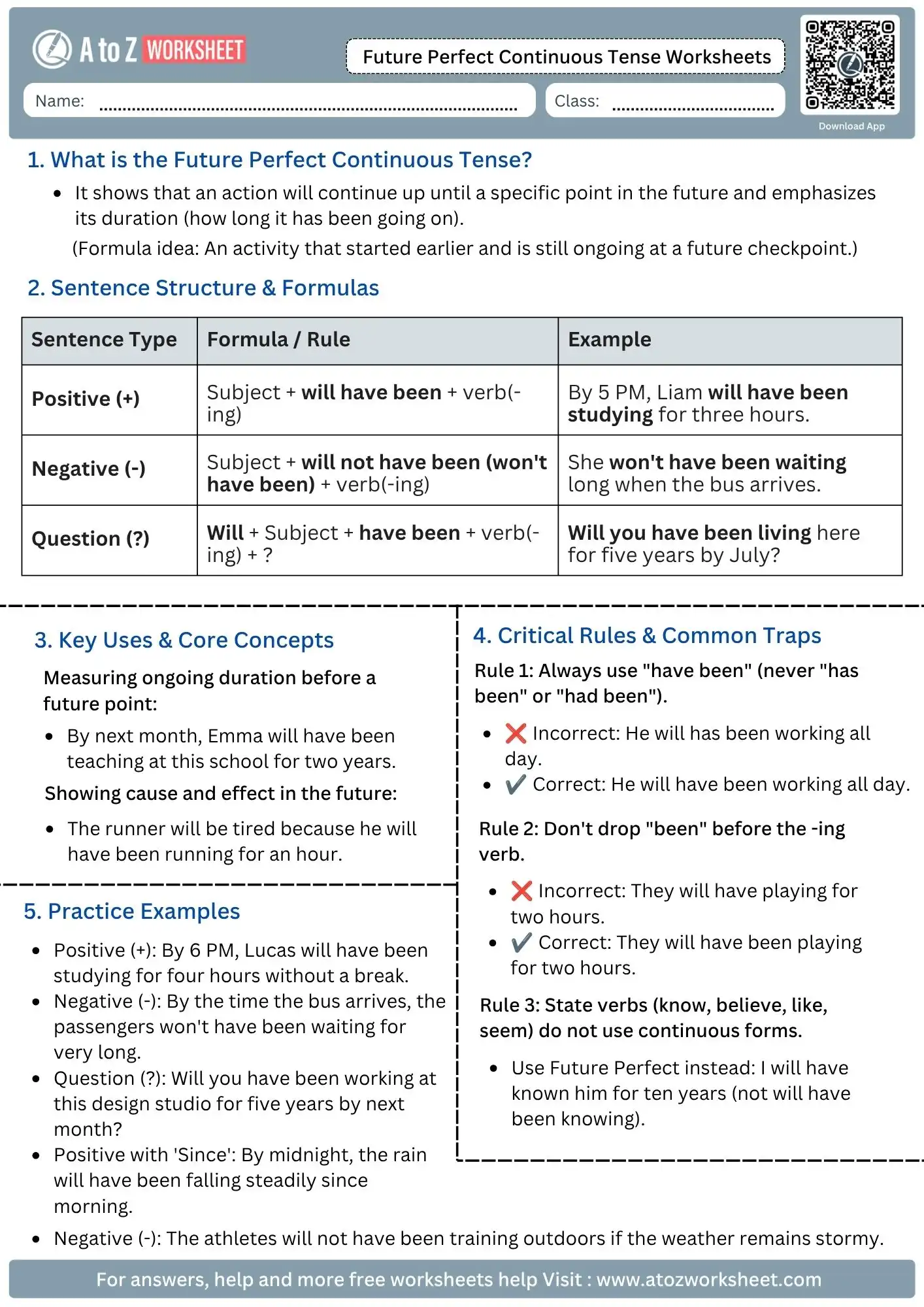
Worksheet: 1 (Future Perfect Continuous Tense – Concept Overview)
- Note: This is an instructional overview and reference sheet designed for single-page A4 printing. No separate answer key is required.
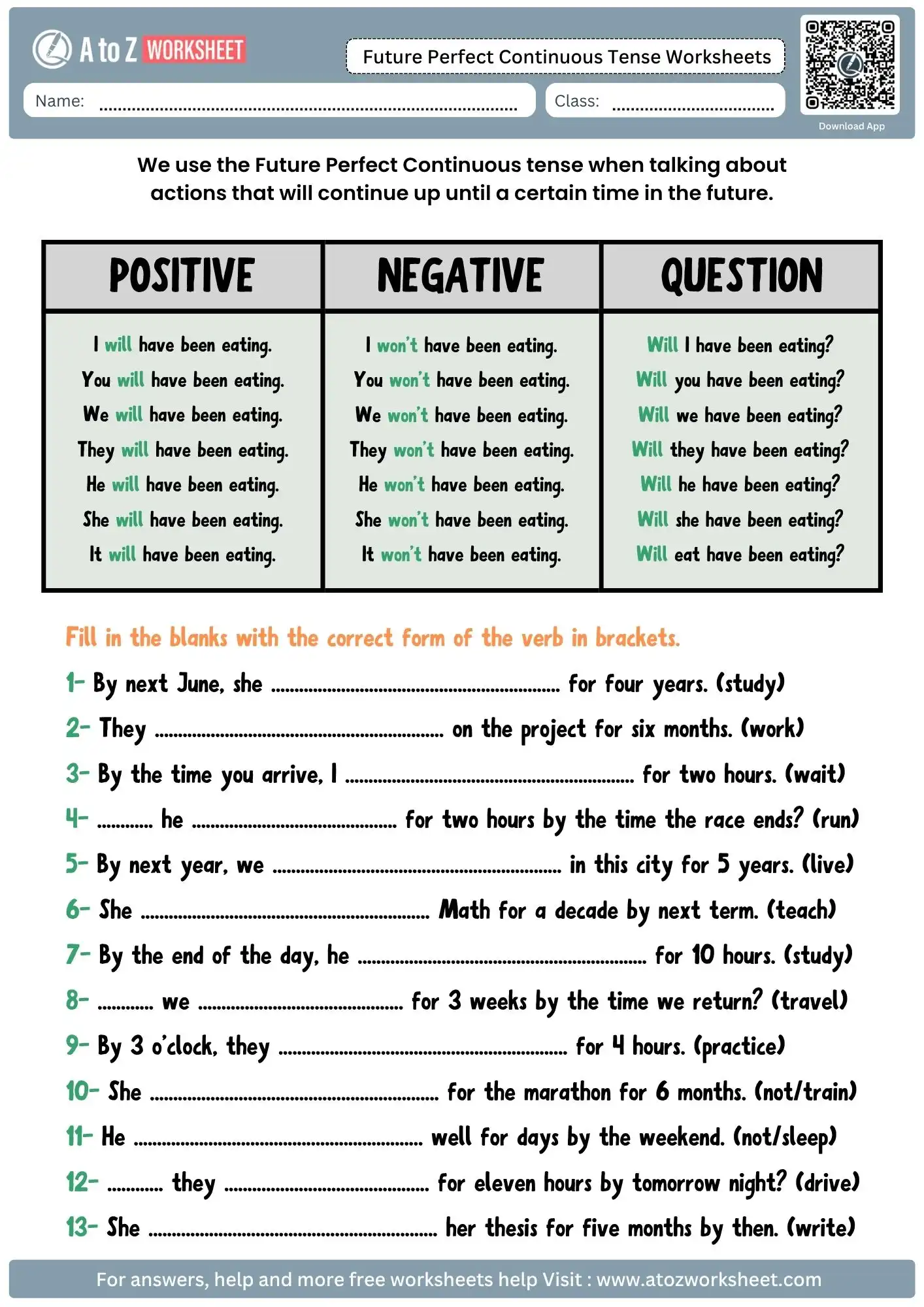
Worksheet 2 (Future Perfect Continuous Tense)
- By next June, she will have been studying for four years.
- They will have been working on the project for six months.
- By the time you arrive, I will have been waiting for two hours.
- Will he have been running for two hours by the time the race ends?
- By next year, we will have been living in this city for 5 years.
- She will have been teaching Math for a decade by next term.
- By the end of the day, he will have been studying for 10 hours.
- Will we have been traveling for 3 weeks by the time we return?
- By 3 o’clock, they will have been practicing for 4 hours.
- She will not have been training (or: won’t have been training) for the marathon for 6 months.
- He will not have been sleeping (or: won’t have been sleeping) well for days by the weekend.
- Will they have been driving for eleven hours by tomorrow night?
- She will have been writing her thesis for five months by then.
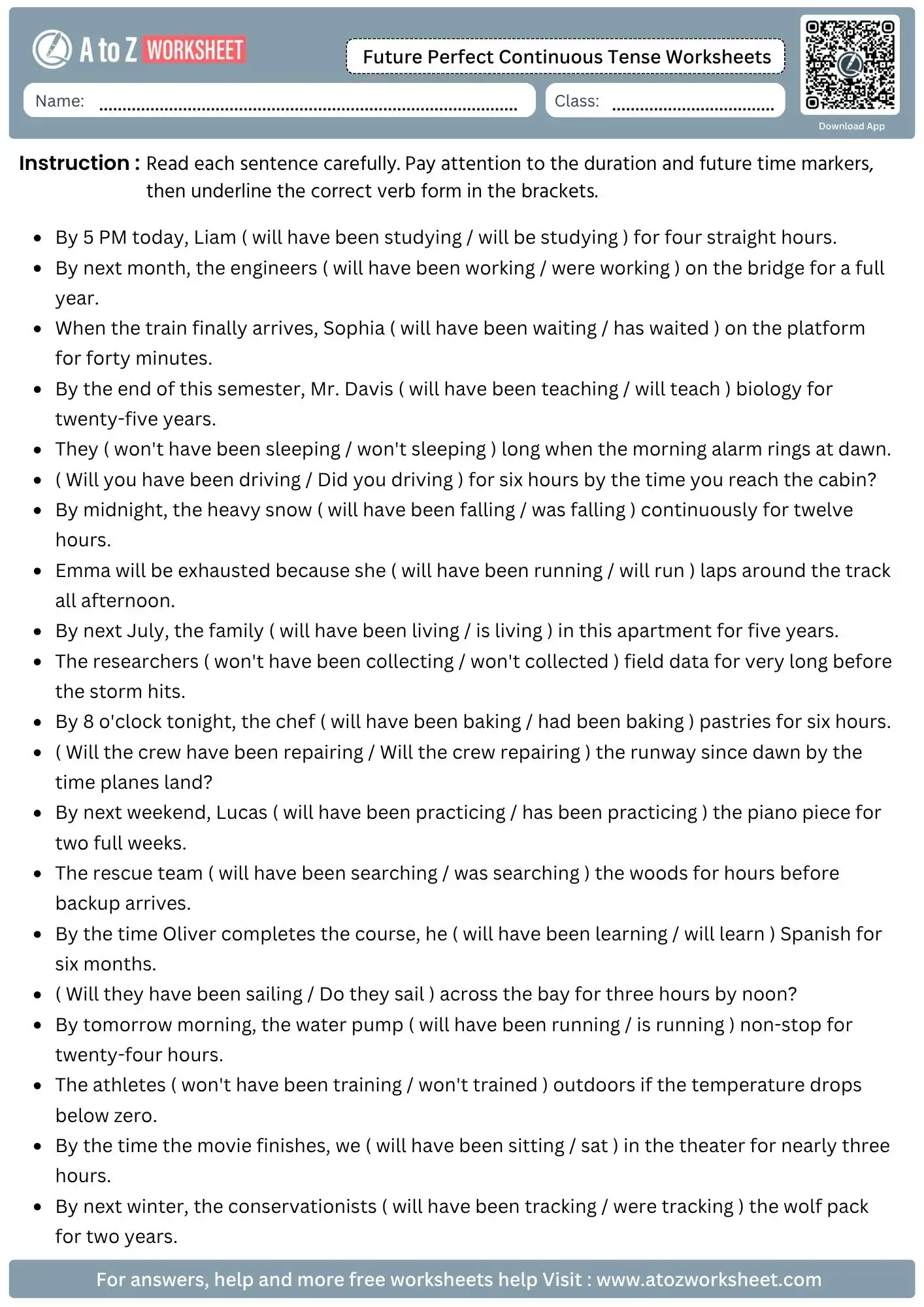
Worksheet: 3 (Future Perfect Continuous Tense – Choose the Correct Verb)
- By 5 PM today, Liam ( will have been studying / will be studying ) for four straight hours.
- By next month, the engineers ( will have been working / were working ) on the bridge for a full year.
- When the train finally arrives, Sophia ( will have been waiting / has waited ) on the platform for forty minutes.
- By the end of this semester, Mr. Davis ( will have been teaching / will teach ) biology for twenty-five years.
- They ( won’t have been sleeping / won’t sleeping ) long when the morning alarm rings at dawn.
- ( Will you have been driving / Did you driving ) for six hours by the time you reach the cabin?
- By midnight, the heavy snow ( will have been falling / was falling ) continuously for twelve hours.
- Emma will be exhausted because she ( will have been running / will run ) laps around the track all afternoon.
- By next July, the family ( will have been living / is living ) in this apartment for five years.
- The researchers ( won’t have been collecting / won’t collected ) field data for very long before the storm hits.
- By 8 o’clock tonight, the chef ( will have been baking / had been baking ) pastries for six hours.
- ( Will the crew have been repairing / Will the crew repairing ) the runway since dawn by the time planes land?
- By next weekend, Lucas ( will have been practicing / has been practicing ) the piano piece for two full weeks.
- The rescue team ( will have been searching / was searching ) the woods for hours before backup arrives.
- By the time Oliver completes the course, he ( will have been learning / will learn ) Spanish for six months.
- ( Will they have been sailing / Do they sail ) across the bay for three hours by noon?
- By tomorrow morning, the water pump ( will have been running / is running ) non-stop for twenty-four hours.
- The athletes ( won’t have been training / won’t trained ) outdoors if the temperature drops below zero.
- By the time the movie finishes, we ( will have been sitting / sat ) in the theater for nearly three hours.
- By next winter, the conservationists ( will have been tracking / were tracking ) the wolf pack for two years.
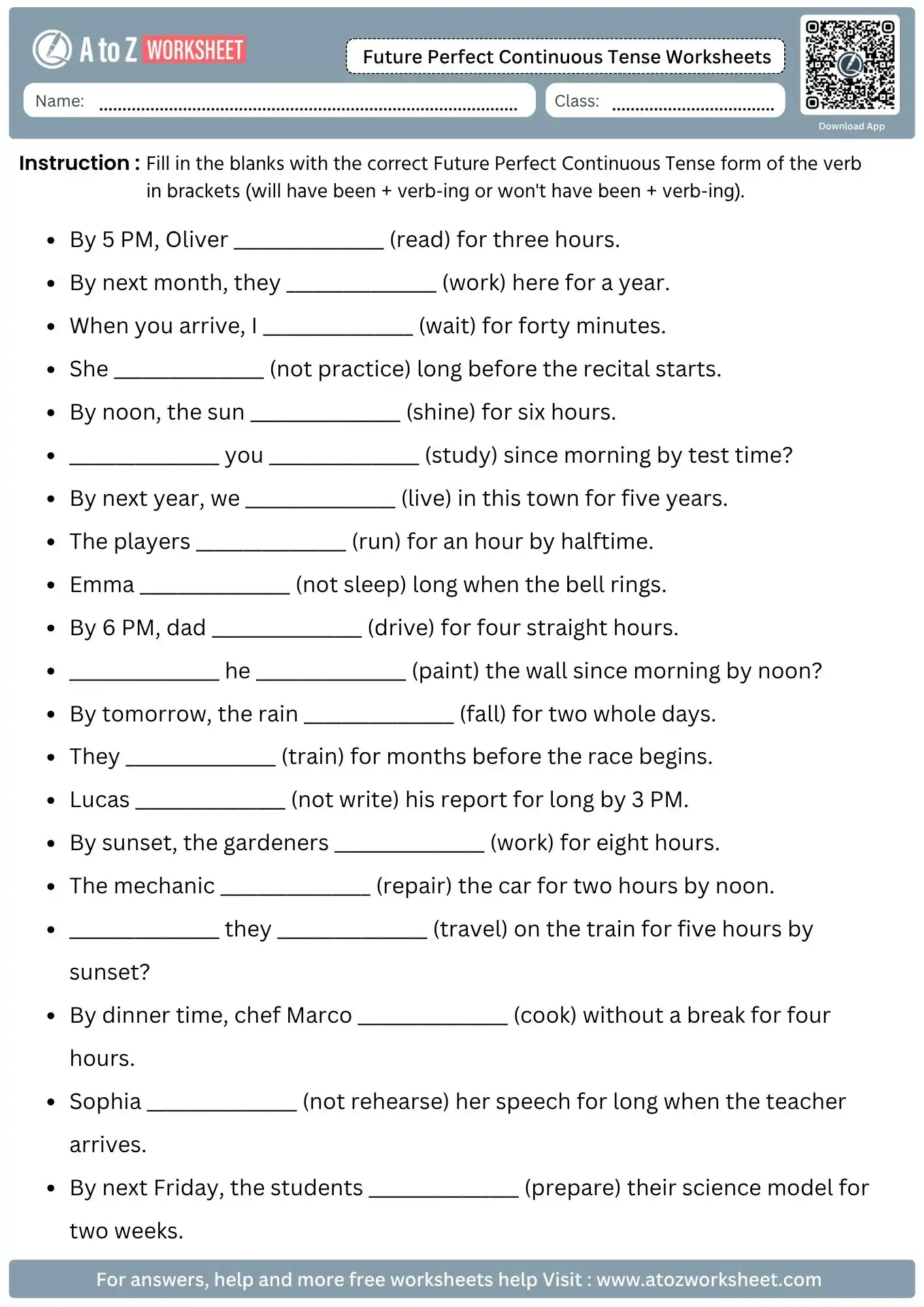
Worksheet: 4 (Future Perfect Continuous Tense – Fill in the Blanks)
- By 5 PM, Oliver will have been reading (read) for three hours.
- By next month, they will have been working (work) here for a year.
- When you arrive, I will have been waiting (wait) for forty minutes.
- She won’t have been practicing / will not have been practicing (not practice) long before the recital starts.
- By noon, the sun will have been shining (shine) for six hours.
- Will you have been studying (study) since morning by test time?
- By next year, we will have been living (live) in this town for five years.
- The players will have been running (run) for an hour by halftime.
- Emma won’t have been sleeping / will not have been sleeping (not sleep) long when the bell rings.
- By 6 PM, dad will have been driving (drive) for four straight hours.
- Will he have been painting (paint) the wall since morning by noon?
- By tomorrow, the rain will have been falling (fall) for two whole days.
- They will have been training (train) for months before the race begins.
- Lucas won’t have been writing / will not have been writing (not write) his report for long by 3 PM.
- By sunset, the gardeners will have been working (work) for eight hours.
- The mechanic will have been repairing (repair) the car for two hours by noon.
- Will they have been traveling (travel) on the train for five hours by sunset?
- By dinner time, chef Marco will have been cooking (cook) without a break for four hours.
- Sophia won’t have been rehearsing / will not have been rehearsing (not rehearse) her speech for long when the teacher arrives.
- By next Friday, the students will have been preparing (prepare) their science model for two weeks.
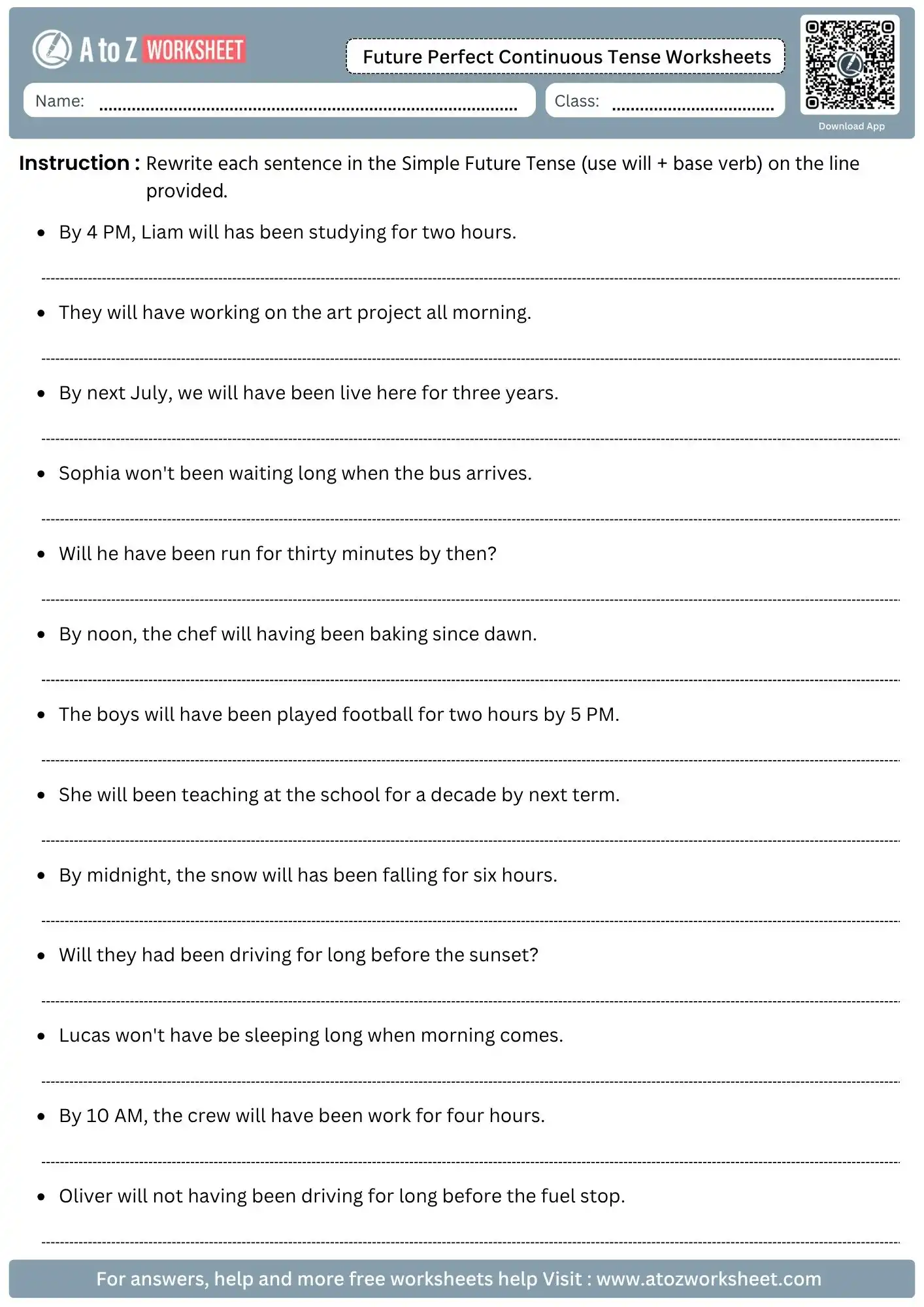
Worksheet: 5 Find the Mistake & Rewrite
- By 4 PM, Liam will have been studying for two hours.
- (Mistake: used “has” instead of “have”)
- They will have been working on the art project all morning.
- (Mistake: missing “been”)
- By next July, we will have been living here for three years.
- (Mistake: used base verb “live” instead of “-ing” form)
- Sophia won’t have been waiting long when the bus arrives.
- (Mistake: missing “have”)
- Will he have been running for thirty minutes by then?
- (Mistake: used base verb “run” instead of “-ing” form)
- By noon, the chef will have been baking since dawn.
- (Mistake: used “having” instead of “have”)
- The boys will have been playing football for two hours by 5 PM.
- (Mistake: used past tense “played” instead of “-ing” form)
- She will have been teaching at the school for a decade by next term.
- (Mistake: missing “have”)
- By midnight, the snow will have been falling for six hours.
- (Mistake: used “has” instead of “have”)
- Will they have been driving for long before the sunset?
- (Mistake: used “had” instead of “have”)
- Lucas won’t have been sleeping long when morning comes.
- (Mistake: used “be” instead of “been”)
- By 10 AM, the crew will have been working for four hours.
- (Mistake: used base verb “work” instead of “-ing” form)
- Oliver will not have been driving for long before the fuel stop.
- (Mistake: used “having” instead of “have”)
Future Perfect Continuous Tense Worksheets PDF Free Download
Download the high-resolution study bundle instantly using the button below for easy printing. This file compiles all five future perfect continuous practice sheets alongside verified answer keys, making it a reliable resource for class lessons, homework, and quick exam review.
Learning Outcome
Working through these drills helps learners from Class 3 to Class 6 express ongoing future actions and measure specific durations with ease. Students will master the “will have been + verb(-ing)” formula across positive, negative, and question forms. They will also identify duration markers like “for” and “since,” avoid non-continuous stative verbs, and convert compound forms into simple future statements.
Related Worksheets May You Like
- Simple Tenses Worksheets With Answers and PDF For Kids
- Tenses Worksheet With Answers and Free PDF
- Free Printable Changing Tense Worksheets (Grade 3 to Grade 5)
- Free Present Tense And Past Tense Worksheets With Answers
- Simple Present Tense Worksheets With Answers and Free PDF
- Past Tense Worksheets PDF with Answers
FAQs
Why is “will has been” incorrect in the future perfect continuous tense?
The modal verb “will” must always be followed by the base auxiliary “have,” meaning “will have been” is the only correct form regardless of whether the subject is singular or plural.
Can we use stative verbs like “know” or “believe” in this tense?
No, state verbs cannot take the continuous “-ing” form. Use the Future Perfect Tense instead (for example, write “will have known” instead of “will have been knowing”).
What do signal words like “for” and “since” show in these sentences?
They measure the duration of an ongoing action before a specific future deadline arrives, such as “for three hours by 5 PM”.
Summary
The future perfect continuous tense tracks how long an activity will be underway before a future milestone arrives. Our future perfect continuous tense worksheets help young learners master the four-part auxiliary chain, steer clear of stative verb traps, and transform complex sentences with ease.
I hope you like it and to get such worksheets for students on different topics, keep visiting our website atozworksheet.com. For instant updates, follow us on Instagram, Facebook, Pinterest, Telegram and subscribe to our YouTube channel.