The degrees of comparison of adjectives worksheets in this collection help students understand how adjectives change when we describe one, two, or more things. These printable activities are perfect for Class 4, Class 5, and Class 6 learners, offering clear examples and simple exercises that build confidence step by step. Each worksheet includes examples, table activities, sorting tasks, rewriting tasks, and fill-in-the-blanks exercises to help children practise properly through a fun, structured learning method.
This set has been designed to support children, teachers, and parents in improving grammar skills in an easy and child-friendly way. The worksheets use simple language, relatable examples, and visual clues so learners understand how adjectives change according to comparison. Whether used at home or in the classroom, these pages help children notice patterns, write better sentences, and express comparisons more clearly.
Degrees of Comparison of Adjectives Worksheets With Answers and PDF For Class 4, Class 5 and Class 6
These worksheets cover basic rules, examples, and different types of questions that help learners understand how adjectives change from positive to comparative and superlative forms. Children compare qualities, rewrite sentences, sort adjectives into categories, and complete meaningful exercises that reinforce learning in a practical, step-by-step method.



Answers
Parents and teachers can use the answer key below to review student work and provide quick feedback. These answers help learners compare their responses, understand mistakes, and build correct usage through guided practice. All answers are written in full sentences to support clear understanding.
Worksheet 1 Answers (What Are Degrees of Comparison?)
- Positive degree: This bag is light.
- Comparative degree: This bag is lighter than that one.
- Superlative degree: This is the lightest bag in the shop.
- tall → taller → tallest
- long → longer → longest
- big → bigger → biggest
- thin → thinner → thinnest
- happy → happier → happiest
- easy → easier → easiest
- more careful → most careful
- more beautiful → most beautiful
- good → better → best
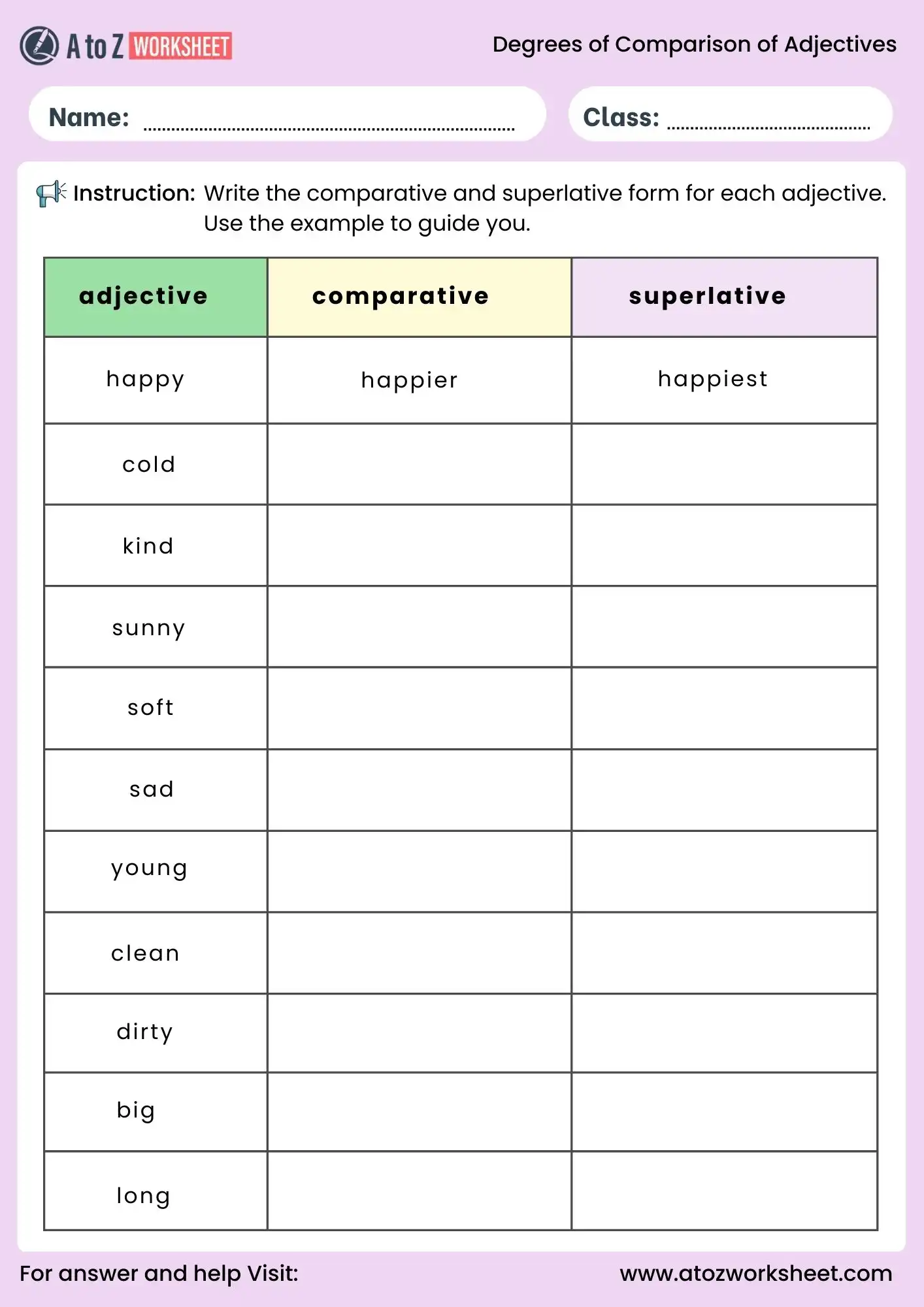
Worksheet 2 Answers (Write the comparative and superlative form)
- cold → colder → coldest
- kind → kinder → kindest
- sunny → sunnier → sunniest
- soft → softer → softest
- sad → sadder → saddest
- young → younger → youngest
- clean → cleaner → cleanest
- dirty → dirtier → dirtiest
- big → bigger → biggest
- long → longer → longest
Worksheet 3 Answers (Sort into Positive, Comparative, Superlative)
- Positive: cold, high, fast, soft, bad, long
- Comparative: heavier, better, deeper, more careful, bigger, worse, stronger, older
- Superlative: brightest, tallest, fastest, strongest, most colourful, largest, happier, most interesting
- Worksheet 4 Answers (Underline the adjective showing degree)
- narrower
- smartest
- lighter
- highest
- more difficult
- cooler
- best
- faster
- smallest
- more interesting
- bright
- cheapest
- warmer
- clearer
- stronger
- longest
- easier
- deep
- better
- most expensive
Worksheet 5 Answers (Fill in the blanks)
- taller
- lighter
- faster
- warmer
- better
- higher
- strongest
- deepest
- clearer
- most beautiful
- softer
- longer
- strongest
- cheapest
- better
- heavier
- longer
- more careful
- lighter
- longest
- strongest
- worse
- greener
- longest
- creative
Worksheet 6 Answers (Rewrite using comparative or superlative)
- This bag is lighter.
- The road is wider.
- The story is more interesting.
- The tower is taller.
- Her handwriting is neater.
- The test is easier.
- The room is brighter.
- The singer is more famous.
- The lion is stronger.
- The weather is warmer.
- The building is higher.
- The shop is cheaper.
- The children are happier.
Degrees of Comparison of Adjectives Worksheets PDF Free Download
This printable file brings all worksheets together in one organised resource so children can practise comparison skills anywhere. The PDF includes explanation charts, sorting tasks, rewriting exercises, and fill-in activities that support step-by-step learning without needing extra preparation.
Learning Outcome
After completing these worksheets, children will understand how adjectives change when comparing one, two, or several things. They will be able to recognise positive, comparative, and superlative forms and apply them correctly in sentences. Students will also improve their writing clarity, grammar accuracy, and ability to describe things more precisely in everyday English.
Related Worksheets May You Like
FAQs
What are degrees of comparison in adjectives?
They show how a quality changes when comparing one item, two items, or more than two items.
How can children learn comparison easily?
By practising with clear examples, rewriting exercises, and table activities like the ones included in these worksheets.
What is the difference between comparative and superlative forms?
Comparative compares two things, while superlative compares three or more.
Are the degrees of comparison of adjectives worksheets suitable for mixed-ability students?
Yes, they include simple and challenging tasks so all learners can progress comfortably.
Summery
These degrees of comparison of adjectives worksheets help Class 4–6 students learn how adjectives change when comparing people, animals, places, and things. With guided examples and structured exercises, children practise forming correct comparative and superlative forms while improving grammar and writing skills.
I hope you like it and to get such worksheets for students on different topics, keep visiting our website atozworksheet.com. For instant updates, follow us on Instagram, Facebook, Pinterest, Telegram and subscribe to our YouTube channel.