Expressing upcoming plans, predictions, and future routines requires a solid grasp of English verb structures and time signals. Our structured future tense worksheets with answers provide learners with an organized way to explore every aspect of upcoming actions. From choosing between spontaneous decisions and planned intentions to constructing ongoing or completed timelines, these exercises guide students toward clear, accurate written expression.
This free printable PDF guide covers all four forms of the future tense alongside essential “will” versus “going to” rules and time-clue markers. With a visual reference chart, verb conversion tables, fill-in-the-blanks, and full sentence-rewriting drills, it offers a complete, self-paced study resource for parents, teachers, and students aiming to build lasting English grammar skills.
Master All 4 Verb Forms Using Future Tense Worksheets with Answers: Free Printable PDF Guide (For Class 2 to Class 5)
Understanding how to describe events yet to happen is an essential milestone in English grammar. This printable PDF pack systematically walks learners through the four major future forms—simple, continuous, perfect, and perfect continuous—using clear rules, signal word clues, and structured exercises. Complete with step-by-step fill-in drills, verb transformation charts, and sentence rewriting tasks, this free worksheet collection gives young writers the practical foundation they need to use future verbs accurately and naturally.
Answers
Check your work using the complete answer key provided below. Reviewing these solutions will help you verify verb choices, clarify differences between simple, continuous, and perfect structures, and ensure every sentence is written with correct English grammar.
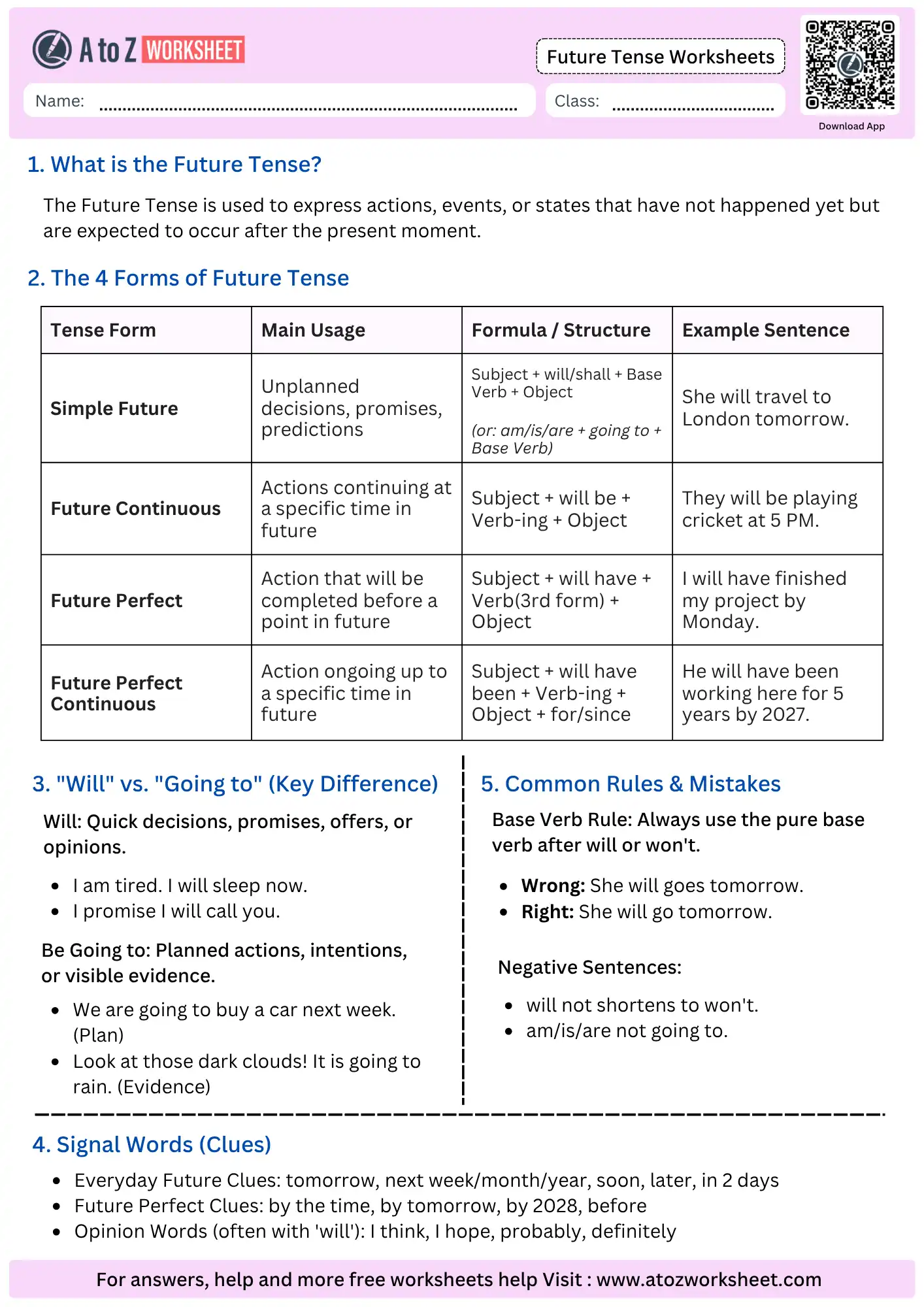
Worksheet 1
- This is a concept overview page, no answers are required.
Quick Examples:
- Simple Future: I will help you clean the classroom.
- Future Continuous: We will be studying when you visit us.
- Future Perfect: The train will have departed by the time we reach.
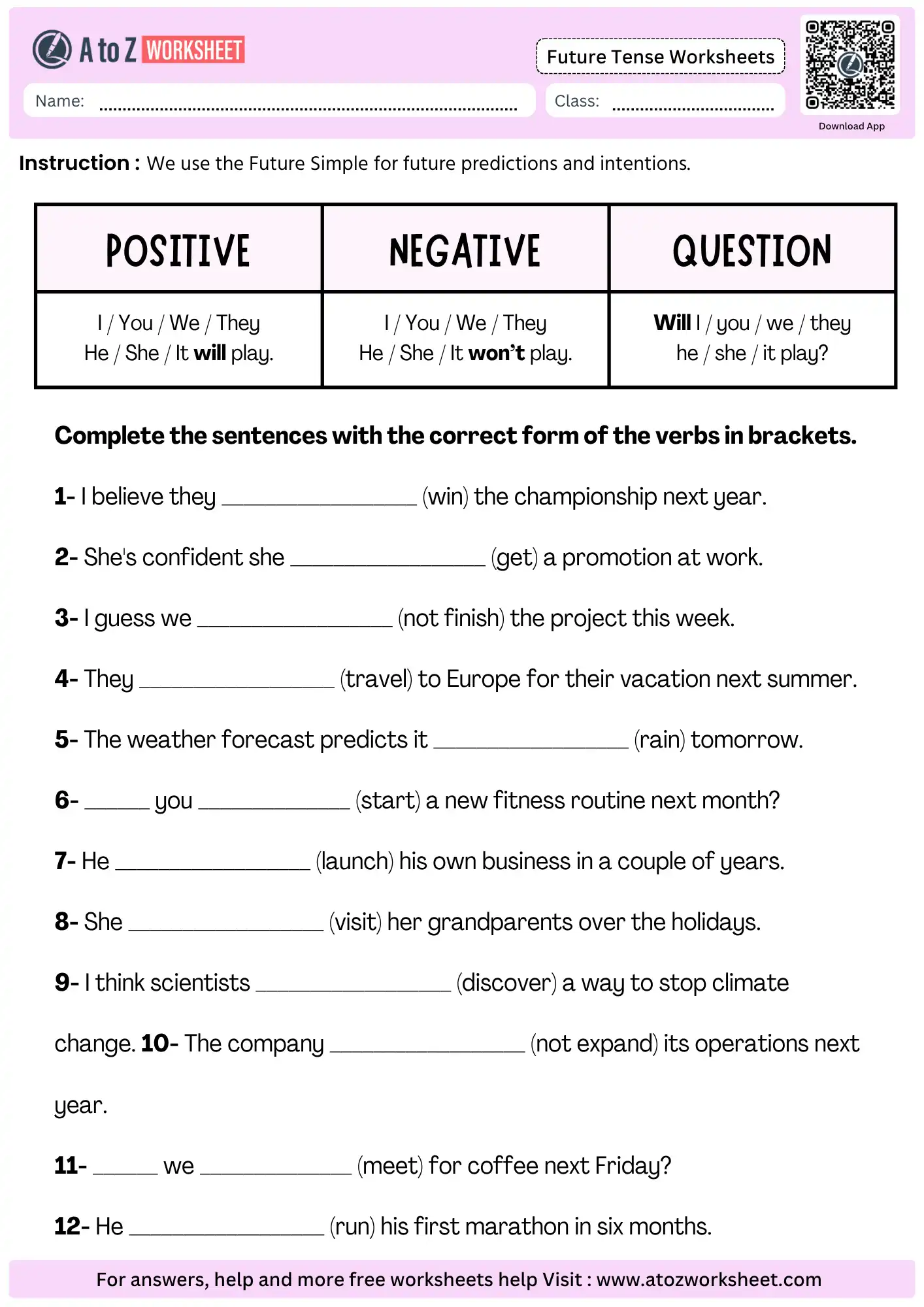
Worksheet 2
- I believe they will win (win) the championship next year.
- She’s confident she will get (get) a promotion at work.
- I guess we will not finish / won’t finish (not finish) the project this week.
- They will travel (travel) to Europe for their vacation next summer.
- The weather forecast predicts it will rain (rain) tomorrow.
- Will you start (start) a new fitness routine next month?
- He will launch (launch) his own business in a couple of years.
- She will visit (visit) her grandparents over the holidays.
- I think scientists will discover (discover) a way to stop climate change.
- The company will not expand / won’t expand (not expand) its operations next year.
- Will we meet (meet) for coffee next Friday?
- He will run (run) his first marathon in six months.
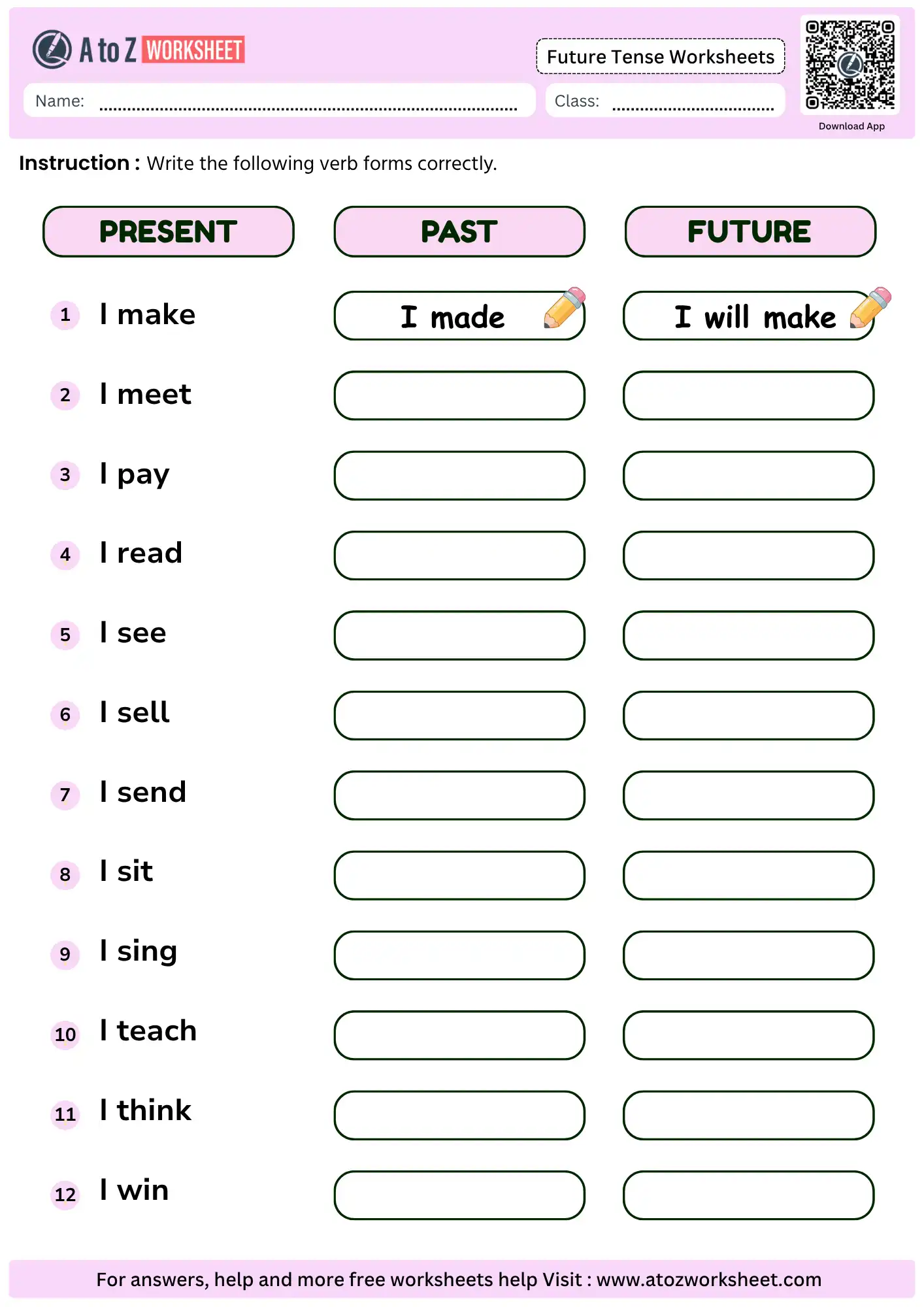
Worksheet 3
| PRESENT | PAST | FUTURE |
| 1. I make | I made | I will make |
| 2. I meet | I met | I will meet |
| 3. I pay | I paid | I will pay |
| 4. I read | I read | I will read |
| 5. I see | I saw | I will see |
| 6. I sell | I sold | I will sell |
| 7. I send | I sent | I will send |
| 8. I sit | I sat | I will sit |
| 9. I sing | I sang | I will sing |
| 10. I teach | I taught | I will teach |
| 11. I think | I thought | I will think |
| 12. I win | I won | I will win |
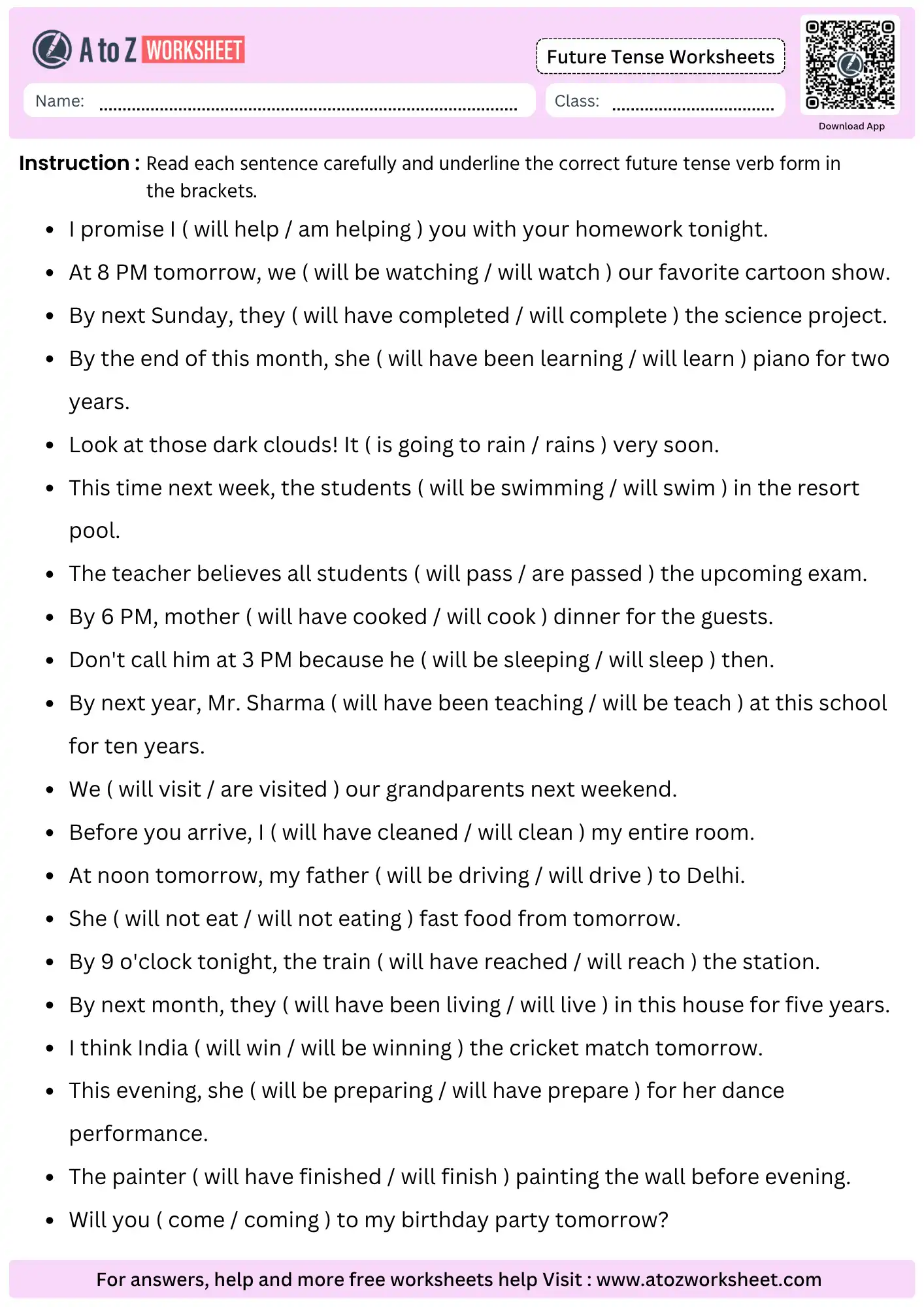
Worksheet 4
- I promise I ( will help / am helping ) you with your homework tonight.
- At 8 PM tomorrow, we ( will be watching / will watch ) our favorite cartoon show.
- By next Sunday, they ( will have completed / will complete ) the science project.
- By the end of this month, she ( will have been learning / will learn ) piano for two years.
- Look at those dark clouds! It ( is going to rain / rains ) very soon.
- This time next week, the students ( will be swimming / will swim ) in the resort pool.
- The teacher believes all students ( will pass / are passed ) the upcoming exam.
- By 6 PM, mother ( will have cooked / will cook ) dinner for the guests.
- Don’t call him at 3 PM because he ( will be sleeping / will sleep ) then.
- By next year, Mr. Sharma ( will have been teaching / will be teach ) at this school for ten years.
- We ( will visit / are visited ) our grandparents next weekend.
- Before you arrive, I ( will have cleaned / will clean ) my entire room.
- At noon tomorrow, my father ( will be driving / will drive ) to Delhi.
- She ( will not eat / will not eating ) fast food from tomorrow.
- By 9 o’clock tonight, the train ( will have reached / will reach ) the station.
- By next month, they ( will have been living / will live ) in this house for five years.
- I think India ( will win / will be winning ) the cricket match tomorrow.
- This evening, she ( will be preparing / will have prepare ) for her dance performance.
- The painter ( will have finished / will finish ) painting the wall before evening.
- Will you ( come / coming ) to my birthday party tomorrow?
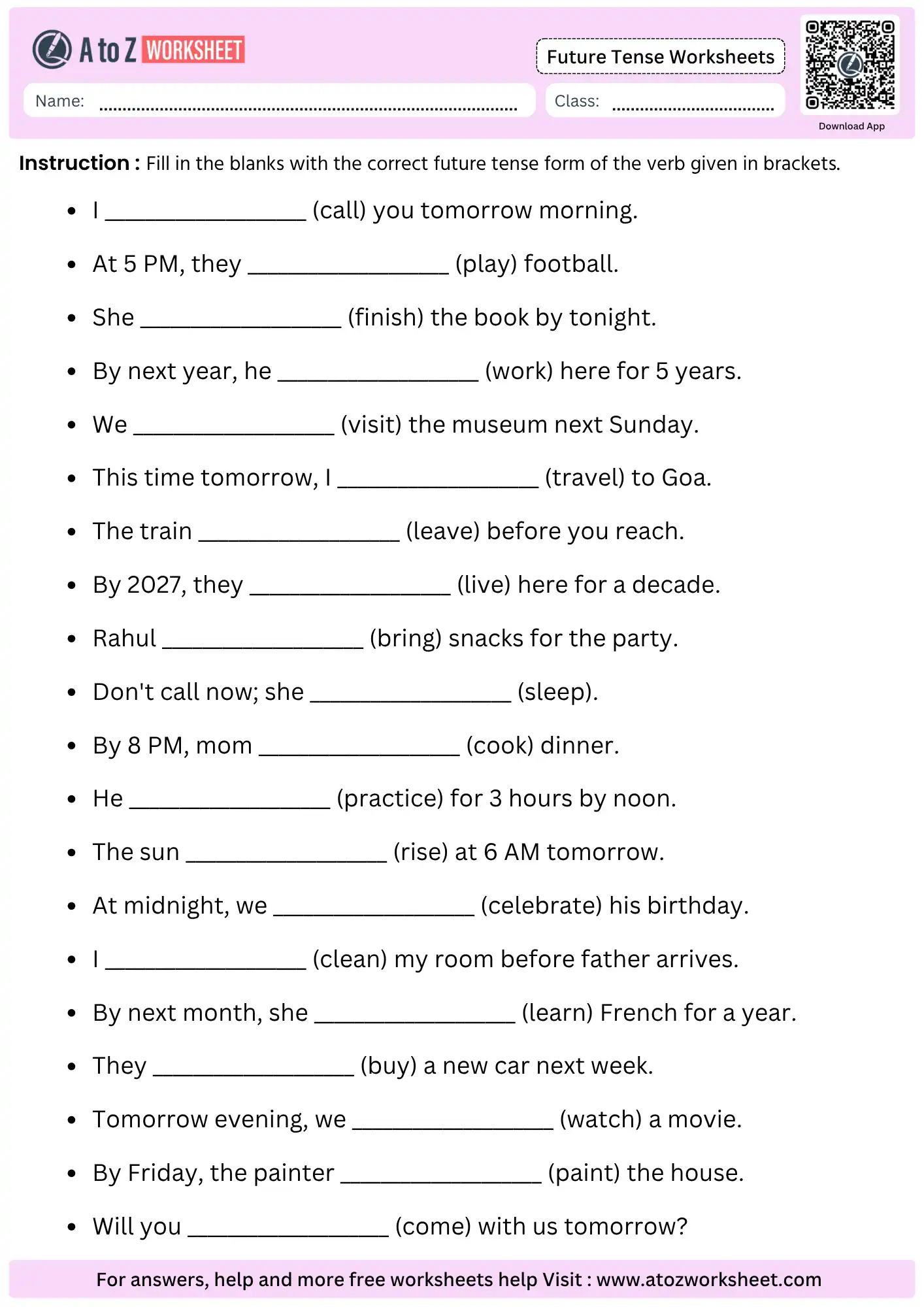
Worksheet 5
- I will call (call) you tomorrow morning.
- At 5 PM, they will be playing (play) football.
- She will have finished (finish) the book by tonight.
- By next year, he will have been working (work) here for 5 years.
- We will visit (visit) the museum next Sunday.
- This time tomorrow, I will be traveling (travel) to Goa.
- The train will have left (leave) before you reach.
- By 2027, they will have been living (live) here for a decade.
- Rahul will bring (bring) snacks for the party.
- Don’t call now; she will be sleeping (sleep).
- By 8 PM, mom will have cooked (cook) dinner.
- He will have been practicing (practice) for 3 hours by noon.
- The sun will rise (rise) at 6 AM tomorrow.
- At midnight, we will be celebrating (celebrate) his birthday.
- I will have cleaned (clean) my room before father arrives.
- By next month, she will have been learning (learn) French for a year.
- They will buy (buy) a new car next week.
- Tomorrow evening, we will be watching (watch) a movie.
- By Friday, the painter will have painted (paint) the house.
- Will you come (come) with us tomorrow?
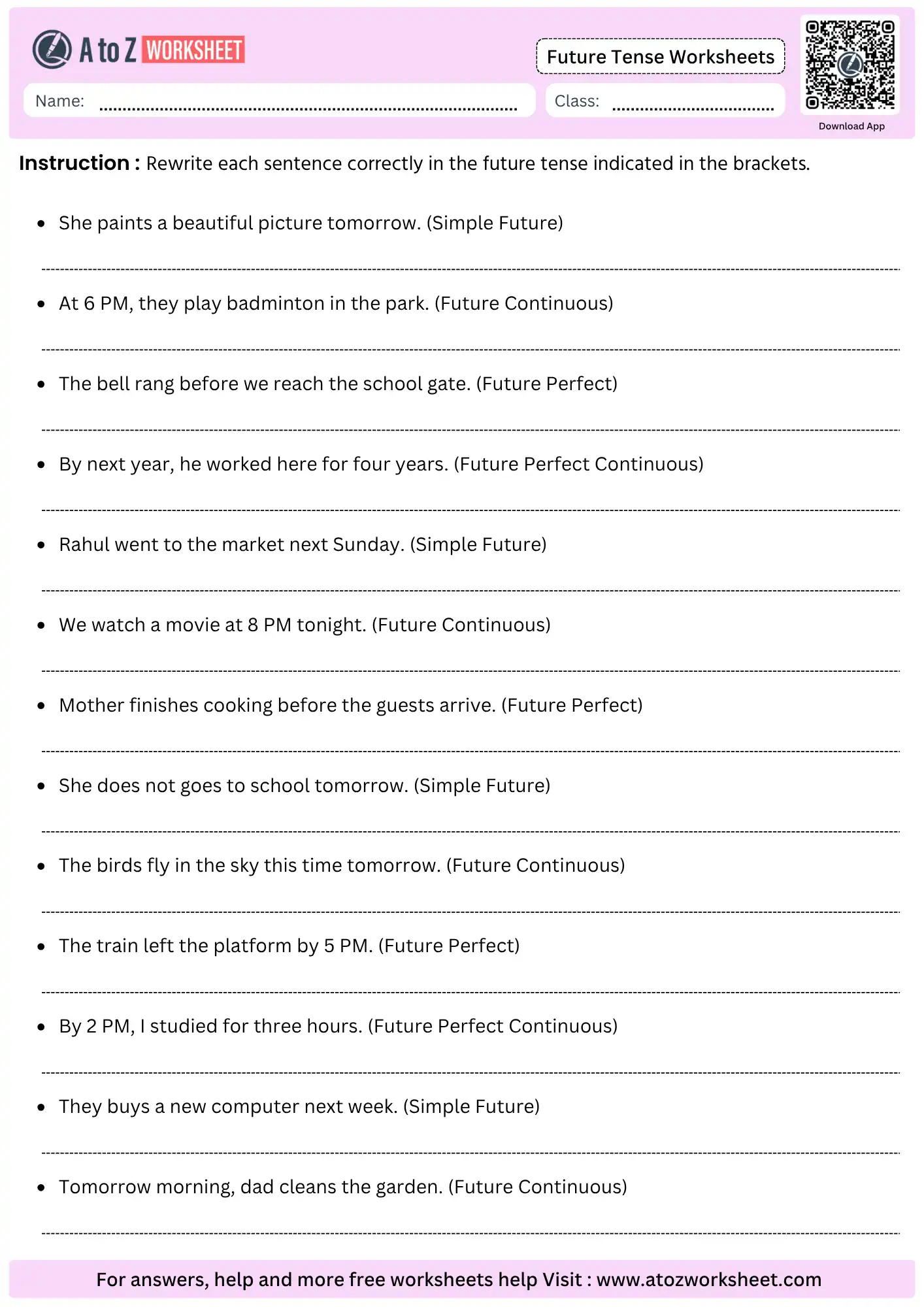
Worksheet 6
- She will paint a beautiful picture tomorrow.
- At 6 PM, they will be playing badminton in the park.
- The bell will have rung before we reach the school gate.
- By next year, he will have been working here for four years.
- Rahul will go to the market next Sunday.
- We will be watching a movie at 8 PM tonight.
- Mother will have finished cooking before the guests arrive.
- She will not go to school tomorrow.
- The birds will be flying in the sky this time tomorrow.
- The train will have left the platform by 5 PM.
- By 2 PM, I will have been studying for three hours.
- They will buy a new computer next week.
- Tomorrow morning, dad will be cleaning the garden.
Future Tense Worksheets PDF Free Download
Download the complete, high-resolution study package instantly using the button below. This printer-friendly file compiles all six instructional charts, practice drills, and sentence-transformation pages alongside complete answer keys, making it an ideal companion for classroom lessons, revision sessions, or guided study at home.
Learning Outcome
By working through these practice exercises, students will develop a firm command of how to express upcoming actions across diverse timelines in English grammar. Learners will gain the confidence to distinguish between unplanned decisions and pre-arranged plans, apply correct formulas for continuous and perfect forms, conjugate base verbs across past, present, and future states, and accurately rewrite full sentences using precise future tense rules.
Related Worksheets May You Like
- Simple Tenses Worksheets With Answers and PDF For Kids
- Tenses Worksheet With Answers and Free PDF
- Free Printable Changing Tense Worksheets (Grade 3 to Grade 5)
- Free Present Tense And Past Tense Worksheets With Answers
- Simple Present Tense Worksheets With Answers and Free PDF
- Past Tense Worksheets PDF with Answers
FAQs
How do these future tense worksheets with answers help learners tell the difference between “will” and “going to”?
Students often treat both forms as identical, which leads to awkward phrasing. These activities provide clear contrasts: “will” is practiced for instant decisions, promises, and spontaneous offers (e.g., “I will call you”), whereas “be going to” is applied to pre-planned intentions or visible evidence (e.g., “Look at those clouds! It is going to rain”).
Why is understanding signal words crucial when studying the future tense?
Time clues act as natural hints that tell learners which specific structure to choose. For example, words like “tomorrow” or “soon” indicate the simple future, while phrases such as “at 5 PM tomorrow” or “by next month” signal ongoing continuous or completed future actions.
What is the most common mistake students make with negative future sentences?
A frequent error is pairing a past or plural form with modal auxiliaries. Learners are reminded through targeted exercises that whether writing positive lines with “will” or negative forms with “won’t,” the main verb must always remain in its pure base form.
Summary
Developing confidence with upcoming timelines is an essential milestone in English language education, and our comprehensive future tense worksheets with answers provide the structured guidance learners need. By combining clear reference charts, regular verb conversion tasks, and full sentence-rewriting exercises, this set helps students master everything from simple intentions to advanced future perfect forms. Download the complete printable file today to give your students a dependable, practical resource that builds lasting grammatical precision and expressive writing skills.
I hope you like it and to get such worksheets for students on different topics, keep visiting our website atozworksheet.com. For instant updates, follow us on Instagram, Facebook, Pinterest, Telegram and subscribe to our YouTube channel.