Understanding how to alter verb timelines is an essential milestone for young kids developing their core writing skills. Utilizing structured changing tense worksheets helps students transition smoothly between regular and irregular active word modifications.
Providing highly visual practice charts ensures that transforming sentences remains engaging rather than repetitive. These free classroom resources are carefully designed to support primary grade language study naturally.
Master English Grammar Tenses Using Free Changing Tense Worksheets With Answers and PDF
Shifting timelines within full sentences requires a clear grasp of historical, present, and upcoming structural markers. The learning layouts provided below give children direct exposure to verb manipulation drills through simple grids and contextual transformation blocks.
Answers
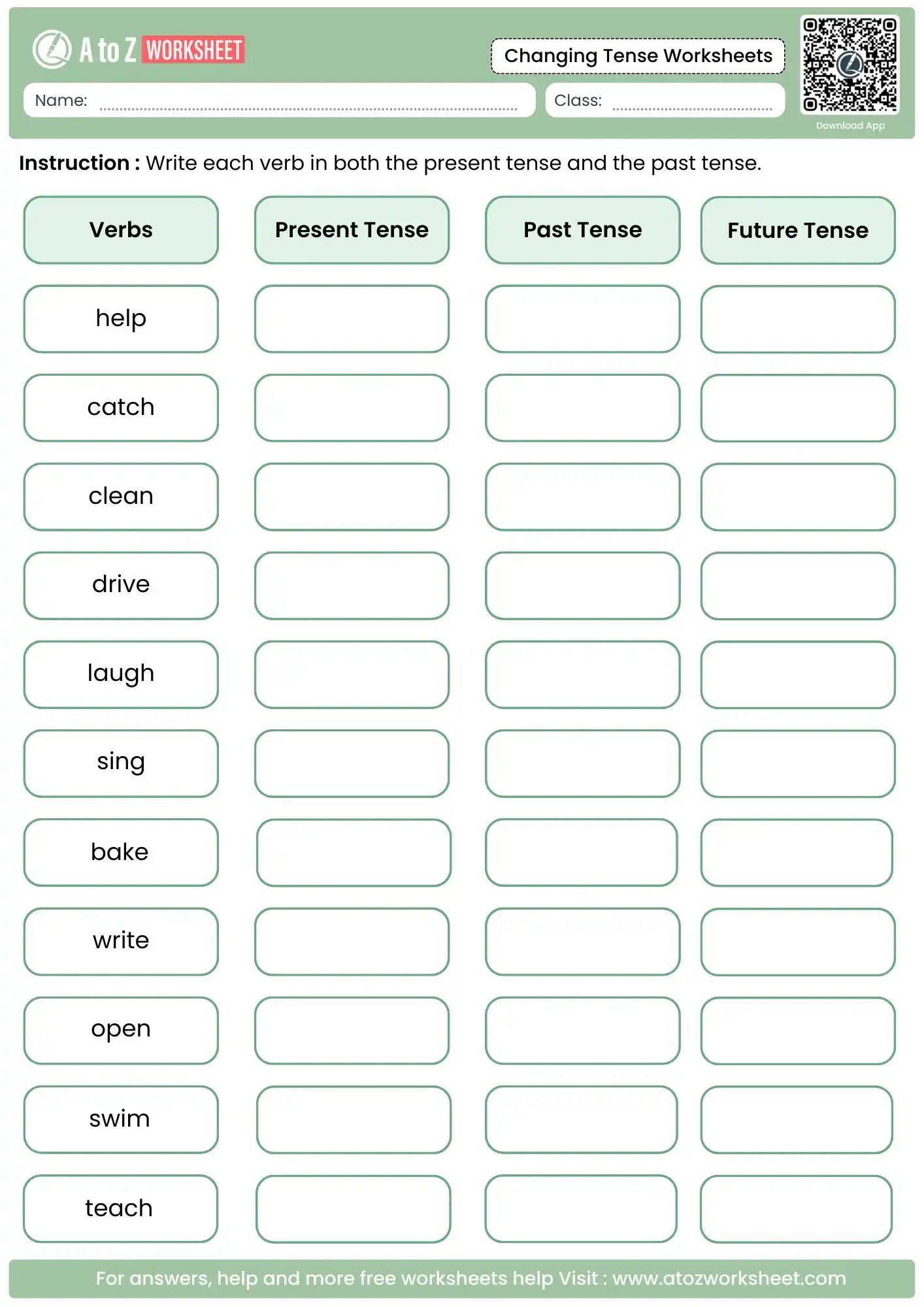
Worksheet 1
- help – help / helps (Present), helped (Past), will help (Future)
- catch – catch / catches (Present), caught (Past), will catch (Future)
- clean – clean / cleans (Present), cleaned (Past), will clean (Future)
- drive – drive / drives (Present), drove (Past), will drive (Future)
- laugh – laugh / laughs (Present), laughed (Past), will laugh (Future)
- sing – sing / sings (Present), sang (Past), will sing (Future)
- bake – bake / bakes (Present), baked (Past), will bake (Future)
- write – write / writes (Present), wrote (Past), will write (Future)
- open – open / opens (Present), opened (Past), will open (Future)
- swim – swim / swims (Present), swam (Past), will swim (Future)
- teach – teach / teaches (Present), taught (Past), will teach (Future)
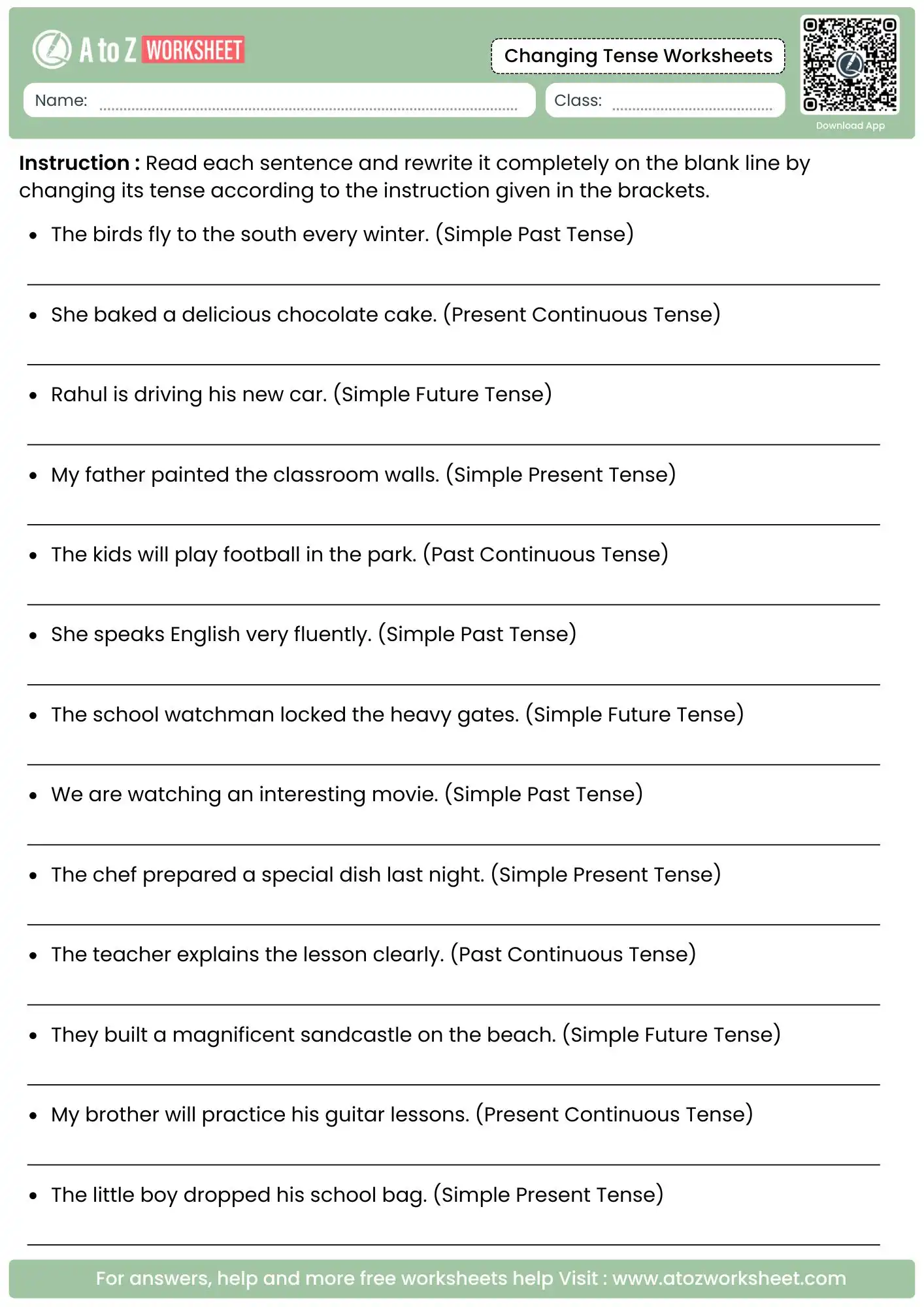
Worksheet 2
- The birds flew to the south every winter. — (Simple Past Tense)
- She is baking a delicious chocolate cake. — (Present Continuous Tense)
- Rahul will drive his new car. — (Simple Future Tense)
- My father paints the classroom walls. — (Simple Present Tense)
- The kids were playing football in the park. — (Past Continuous Tense)
- She spoke English very fluently. — (Simple Past Tense)
- The school watchman will lock the heavy gates. — (Simple Future Tense)
- We watched an interesting movie. — (Simple Past Tense)
- The chef prepares a special dish tonight. — (Simple Present Tense)
- The teacher was explaining the lesson clearly. — (Past Continuous Tense)
- They will build a magnificent sandcastle on the beach. — (Simple Future Tense)
- My brother is practicing his guitar lessons. — (Present Continuous Tense)
- The little boy drops his school bag. — (Simple Present Tense)
Changing Tense Worksheets PDF Free Download
Educators and parents can immediately save this full collection of printable study pages to augment their weekly homework schedules. Click the link highlighted below to access the high-resolution digital files.
Learning Outcome
Working through variable sentence structures enables young children to read critically and track chronological narratives with ease. Developing consistency with these structural shifts eliminates typical language agreement mistakes and establishes a stronger foundation for creative composition.
Related Worksheets May You Like
- Tenses Worksheet With Answers and Free PDF
- Simple Tenses Worksheets With Answers and PDF For Kids
- Preposition Worksheets With Answers and Free PDF For Kids
- Adjectives Worksheets (With Answers and Free PDF)
- Picture Composition Worksheets With Answers and Free PDF
- Parts of Speech Worksheets (With Answers and Free PDF)
- Adverbs Worksheets (With Answers and Free PDF)
- Regular And Irregular Verbs Worksheets (Free PDF)
FAQs
What is the most effective approach for introducing variable timelines to primary grades?
sing simple physical actions paired with timeline words like “yesterday” or “tomorrow” establishes an immediate connection. Reinforcing these patterns with targeted changing tense worksheets helps students solidify the structural rules behind converting active expressions.
How do children learn to recognize irregular variations during shifts?
Unlike standard words that use predictable structural endings, irregular forms follow unique patterns that are best memorized through contextual reading exposure and repeated writing drills.
Why do students frequently forget to alter auxiliary terms when modifying phrases?
Young learners often adjust the main action word but overlook supporting terms like “is,” “was,” or “will,” which requires targeted sentence rewriting practice to correct.
Summary
Introducing clear visual tools is a great way to help young minds turn abstract language rules into confident writing habits. By making these changing tense worksheets a regular part of your study plan, you give children the tools they need to communicate clearly in any timeframe.
I hope you like it and to get such worksheets for students on different topics, keep visiting our website atozworksheet.com. For instant updates, follow us on Instagram, Facebook, Pinterest, Telegram and subscribe to our YouTube channel.